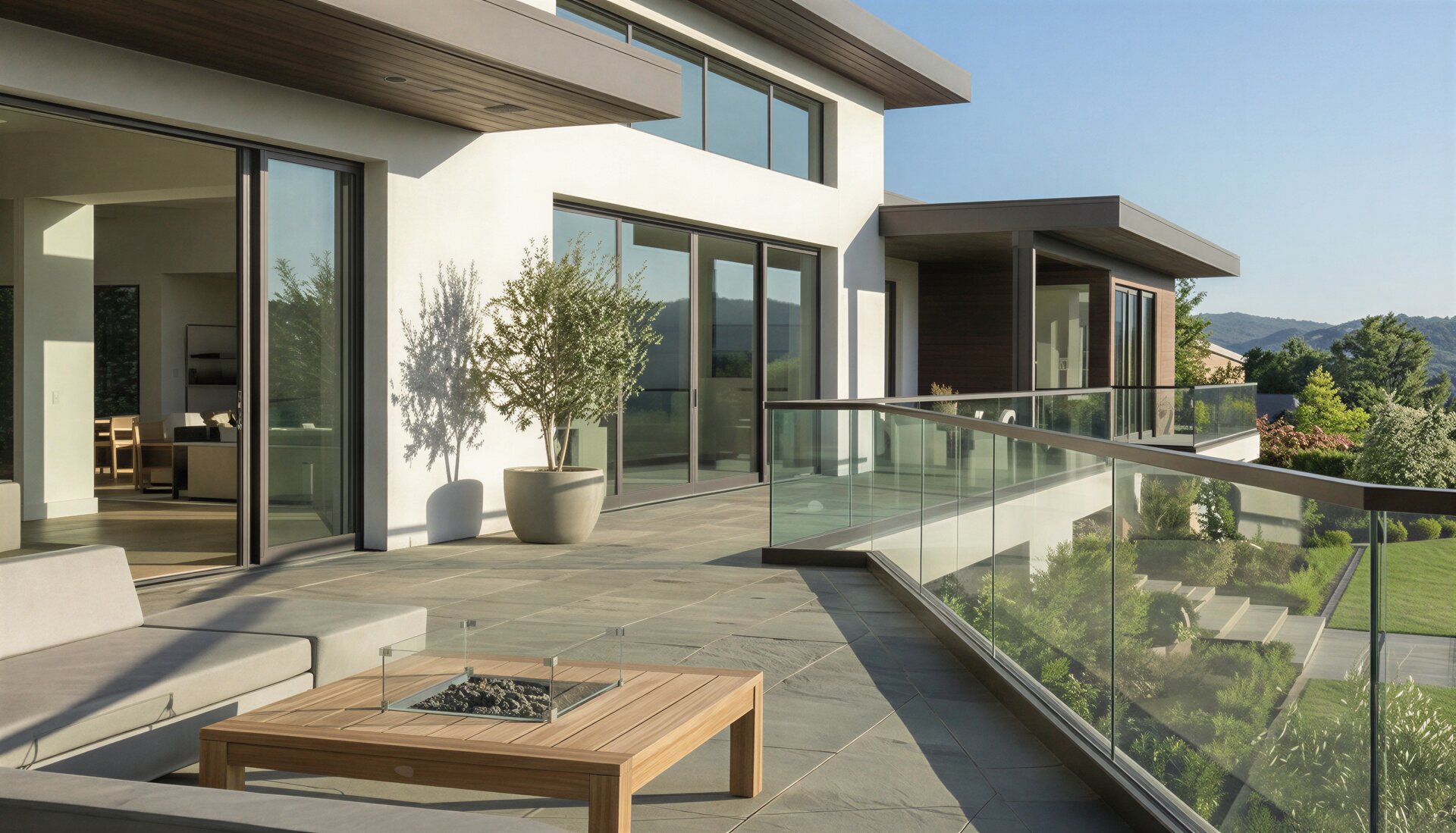
Four-Season Performance
Seattle's defining challenge is not temperature (a mild -10 F to 95 F range) but constant moisture, so every mounting point is detailed for drainage and waterproofing to keep water out of the structure below. Marine air off Puget Sound favors 316-grade stainless hardware for corrosion resistance. Design wind speeds across western Washington run roughly 90 to 100 mph (3-second gust, ASCE 7-16, Risk Category II per SDCI guidance), and seismic loading from the Cascadia Subduction Zone governs connection design more than wind does.
Recommended Systems for Seattle
Four-season climates require glass systems engineered for the full temperature range with freeze-thaw resistant mounting, proper drainage provisions, and hardware rated for both summer heat and winter cold. INFINITYGLASS temperate-climate specifications balance durability with cost-efficiency for moderate engineering requirements.
Boundless Frameless Railing
Engineered for Seattle conditions with site-specific calculations and local code compliance.
Learn more →Framed Post Railing
Engineered for Seattle conditions with site-specific calculations and local code compliance.
Learn more →High-Wall Enclosure System
Engineered for Seattle conditions with site-specific calculations and local code compliance.
Learn more →INFINITYFLEX Modular Partition
Engineered for Seattle conditions with site-specific calculations and local code compliance.
Learn more →Popular Projects in Seattle
Building Codes & Regulations
Seattle permits through the Seattle Department of Construction and Inspections (SDCI) under the Seattle Building Code, the city's amended edition of the 2021 Washington State Building Code (based on the IBC). Guards on surfaces more than 30 inches above grade must resist a 50 lb per linear foot load and a 200 lb concentrated load (IBC Section 1607.9). Glass used in a guard must be laminated tempered or laminated heat-strengthened glass with a factor of safety of four (IBC Section 2407), certified to CPSC 16 CFR 1201 Category II or ANSI Z97.1 Class A. Where laminated balusters are used, a continuous top rail is not required with building-official approval, which is how our Boundless frameless railing holds a true top-rail-free sightline while staying code-compliant. Seattle sits in Seismic Design Category D because of the Cascadia Subduction Zone, so every base and fascia connection is engineered for seismic drift, and SDCI publishes local wind-load and topographic (Kzt) factors that our per-project engineering applies.
INFINITYGLASS™ provides PE-stamped engineering drawings for permit submittal in Seattle and all Washington jurisdictions. Washington Building Codes Guide →
| Item | Requirement |
|---|---|
| Permitting authority | Seattle Department of Construction and Inspections (SDCI), filed through the Seattle Services Portal |
| Governing code | 2021 Seattle Building Code, effective 2024-11-15, based on the 2021 IBC with Washington State and Seattle amendments |
| Guard loads | IBC 1607.9: 50 lb per linear foot, 200 lb concentrated, applied non-concurrently |
| Infill and balusters | 50 lb concentrated on a 1 sq ft area (ASCE 7 Section 4.5.1.2) |
| Guard glazing | Laminated fully tempered or heat-strengthened, CPSC 16 CFR 1201 Category II or ANSI Z97.1 Class A, 1/4 in minimum nominal |
| Design basis | Safety factor of four against mean modulus of rupture (IBC 2407.1.1) |
| Panel redundancy | Minimum three glass balusters per guard section, or support that holds the guard in place if one panel fails (IBC 2407.1.3) |
| Wind | ASCE 7-16 per the 2021 code basis. SDCI publishes its own Wind Load Factors map, so exposure and terrain adjustment are read from the city map rather than assumed |
| Seismic | High-seismic. Category and site class established per project under SBC Chapter 16 |
| Pool barrier | 48 in minimum, per the 2021 ISPSC adopted statewide via WAC 51-51-0327, effective 2024-03-15 |
| Step | Detail |
|---|---|
| Guard engineering | Deferred submittal under SBC 107.3.4.1, requires the building official's prior approval |
| Seal required | Washington-licensed PE on the deferred guardrail package |
| Sequence | Deferred documents are reviewed and stamped by the design professional in responsible charge before submission; no installation until the building official approves |
| Landmark buildings | Certificate of Approval from the Seattle Landmarks Preservation Board before altering controlled exterior features |
| Design Review | Voluntary as of 2025-10-26 under temporary rules aligning with HB 1293 |
| Energy | 2021 Seattle Energy Code, stricter than the state code; glazing carries NFRC labelling |
Why Seattle guard anchorage is a seismic problem before it is a wind problem
Most coastal markets design a glass guard around wind. Seattle is the inverse. The city sits above the Seattle Fault Zone, an east-west thrust system running roughly 70 km directly beneath the urban core and capable of a magnitude 7.0 to 7.5 event, with the Cascadia Subduction Zone and deep intraslab events layered on top. The practical consequence for a glass guard is not panel thickness, it is the connection. Base shoes, fascia brackets and embed plates have to accommodate seismic drift without transferring it into the glass, and the engineering conversation moves from the panel to the substrate it is fixed to.
Seattle also does not let you assume your exposure category. SDCI publishes a Wind Load Factors map precisely because terrain adjustment across the city departs from generic values, so a Puget Sound shoreline parcel and an inland Capitol Hill parcel are not designed to the same thing. INFINITYGLASS™ systems are engineered per project against the SDCI map and the site's own seismic parameters rather than a regional default.
Seattle submarkets we serve
South Lake Union and the Denny Triangle for tech campus interiors and amenity decks. Belltown and the downtown core for high-rise terrace guards. Capitol Hill and Ballard for mid-rise multifamily. The Alki and Elliott Bay waterfront for view railings, where exposure and marine air both escalate. Across the lake, downtown Bellevue and Carillon Point in Kirkland.
Frequently Asked Questions: Glass Fencing in Seattle
Do Seattle glass railings need seismic engineering?
Yes. Seattle is in Seismic Design Category D due to the Cascadia Subduction Zone, so guard connections must accommodate seismic drift and dynamic loading. We provide seismic-compliant engineering and PE-stamped drawings for every Pacific Northwest installation.
Can a frameless glass railing skip the top rail under Seattle code?
Yes, when the glass balusters are laminated glass of two or more equal plies and the building official approves (IBC Section 2407). Our Boundless system uses laminated glass to deliver a genuinely top-rail-free look while meeting the 50 plf and 200 lb guard loads.
How do glass railings hold up to Seattle rain and marine air?
The glass itself is impervious to rain; the engineering focus is drainage at the base shoe and every connection to prevent water intrusion. For salt-laden marine air off Puget Sound we specify 316-grade stainless hardware for long-term corrosion resistance.
What wind load are Seattle installations designed for?
Western Washington design wind speeds are roughly 90 to 100 mph (3-second gust, ASCE 7-16, Risk Category II). We apply SDCI's local wind-load and topographic factors per project rather than generic values.
What glass system works for a Seattle rooftop restaurant?
Full-height enclosure systems give rain and wind protection while keeping natural light and Sound or mountain views open. Operable panels let the space open up on dry summer days.
What height does a Seattle residential pool barrier need to be?
Residential pool barriers require a minimum 48-inch height with self-closing, self-latching gates under the adopted code. Frameless glass meets this while keeping the poolscape open.