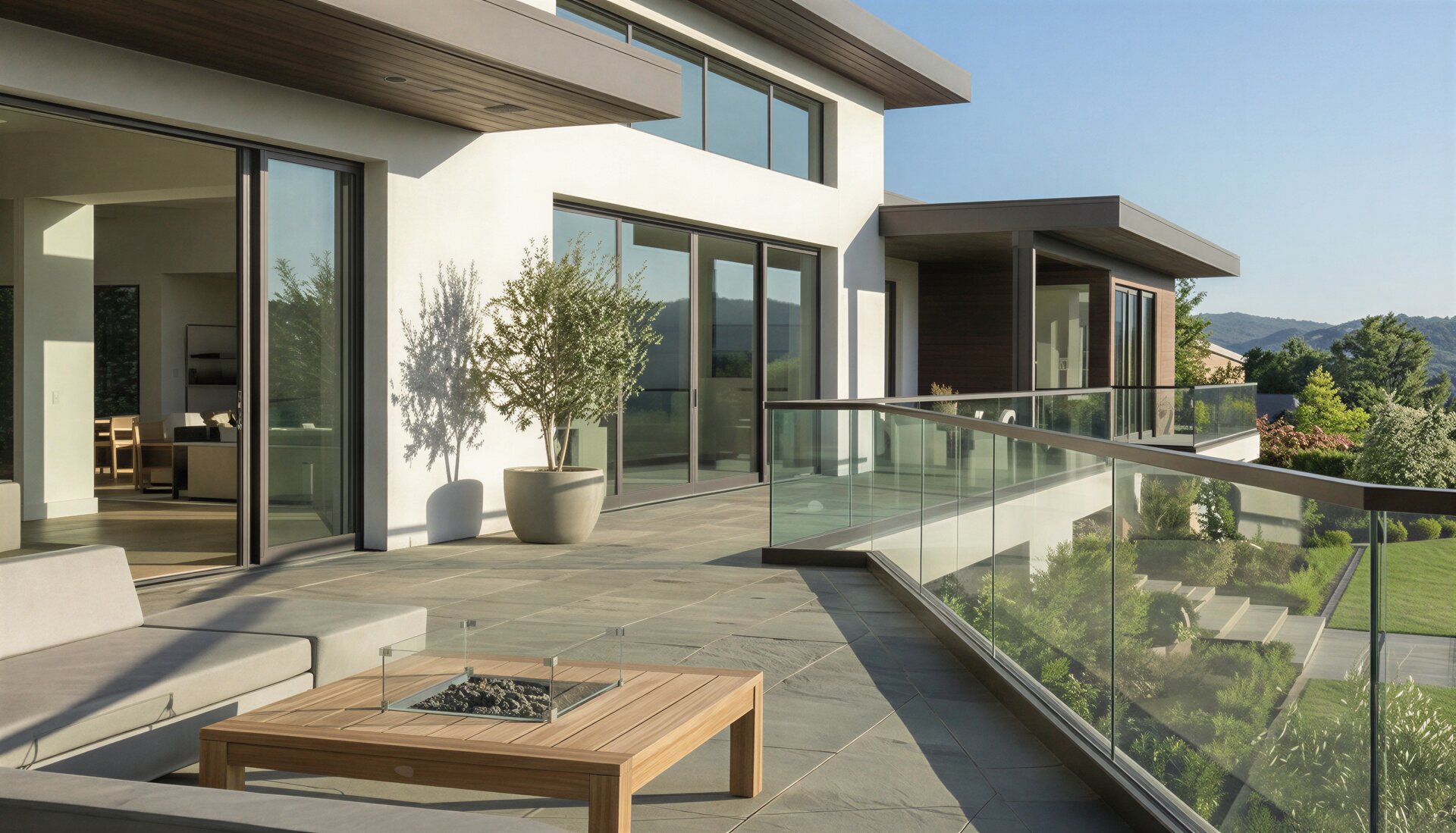
Four-Season Performance
St. Louis combines a genuine freeze-thaw cycle with humid summers and a meaningful severe-weather exposure, including straight-line thunderstorm winds and hail. Freeze-thaw governs base connection detailing, and hail exposure is worth discussing at specification, since laminated makeups behave differently from monolithic tempered under impact.
Recommended Systems for St. Louis
Four-season climates require glass systems engineered for the full temperature range with freeze-thaw resistant mounting, proper drainage provisions, and hardware rated for both summer heat and winter cold. INFINITYGLASS temperate-climate specifications balance durability with cost-efficiency for moderate engineering requirements.
Boundless Frameless Railing
Engineered for St. Louis conditions with site-specific calculations and local code compliance.
Learn more →Framed Post Railing
Engineered for St. Louis conditions with site-specific calculations and local code compliance.
Learn more →High-Wall Enclosure System
Engineered for St. Louis conditions with site-specific calculations and local code compliance.
Learn more →INFINITYFLEX Modular Partition
Engineered for St. Louis conditions with site-specific calculations and local code compliance.
Learn more →Popular Projects in St. Louis
Building Codes & Regulations
Missouri has no statewide commercial building code, so adoption happens locally, and St. Louis is a case where that distinction has practical consequences. The City of St. Louis adopted the 2018 International Building Code by ordinance in August 2018, administered by the Building Division within the Department of Public Safety, and maintains its own local amendments. St. Louis County adopts separately, so two projects a few miles apart can be reviewed against different code editions and different amendment sets depending on which side of the city line they sit on. Confirming the reviewing jurisdiction before design is not a formality here. Under the 2018 IBC, guards follow Section 1015 at 42 inches minimum for most occupancies, and guard glazing follows Section 2407 with Category II of CPSC 16 CFR Part 1201 or Class A of ANSI Z97.1. Commercial plan review in the metro commonly runs several weeks, so submittal completeness affects schedule directly.
INFINITYGLASS™ provides PE-stamped engineering drawings for permit submittal in St. Louis and all Missouri jurisdictions.
| Item | Requirement |
|---|---|
| Permitting authority | City of St. Louis Building Division, Department of Public Safety; Plan Exam section reviews construction documents |
| Governing code | 2018 International Building Code, Ordinance 70794, adopted 2018-08-01 and still the adopted edition |
| Companion codes | 2018 IEBC, IRC, IECC, IPMC, IFC, IMC, IFGC; 2017 NEC; 2021 Uniform Plumbing Code |
| State context | Missouri has no mandatory statewide commercial building code. Adoption is municipal |
| Jurisdiction warning | The City of St. Louis and St. Louis County are separate jurisdictions on different code editions |
| Guard loads | IBC 1607.8, not 1607.9: 50 lb per linear foot (1607.8.1), 200 lb concentrated (1607.8.1.1), 50 lb on a 1 sq ft area for infill (1607.8.2) |
| Guard glazing | Laminated fully tempered or heat-strengthened, safety factor of four per IBC 2407.1.1 |
| Wind | ASCE 7-16 per the 2018 IBC basis; non-hurricane interior; value determined site-specifically |
| Seismic | Live consideration. The New Madrid Seismic Zone is the most seismically active area of the United States east of the Rocky Mountains and St. Louis is within its influence area |
| Energy | 2018 IECC |
| Step | Detail |
|---|---|
| Guard engineering | Deferred submittal under IBC 107.3.4.1 |
| Seal required | Missouri-licensed PE or architect on commercial construction documents |
| Plan Exam | Staffed by licensed design professionals; commercial work requires full review |
| Historic, and this is a hard gate | The Cultural Resources Office reviews all exterior work in local historic districts, on City Landmarks, in public parks and public buildings. No permit may be issued without CRO or Preservation Board approval |
| Volume | CRO reviews roughly 2,000 permits a year |
| Appeals | The Preservation Board, a nine-member mayoral-appointed panel, reviews major development in historic districts and hears appeals of CRO director decisions |
The only market in our footprint where the building code is older and the seismic risk is real
Two things make St. Louis unusual and they pull in opposite directions.
First, the City is still on the 2018 IBC, which means guard loads cite Section 1607.8, not the 1607.9 that applies in every 2021-or-later jurisdiction. The numbers are identical. The citation is not. A submittal that cites 1607.9 against the City's adopted code is citing a section that does not exist in the adopted edition, and it is the kind of error a plan examiner notices immediately. It is also worth being precise that St. Louis County is a separate jurisdiction on a different edition, so a County reference is not a City reference.
Second, and more consequential for the hardware: this is the one market in our footprint east of the Rockies where seismic anchorage is a live design driver rather than a formality. The New Madrid Seismic Zone is the most seismically active region in the eastern United States and St. Louis sits within its influence area. Seismic design category and site class have to be established per project, and the connection detail, not the glass, is where that shows up.
The third St. Louis fact is procedural and it is stricter than it looks. The Cultural Resources Office is not a parallel review that runs alongside the building permit. No permit issues without its approval. For a Central West End or Washington Avenue loft property, CRO approval is the critical path.
St. Louis submarkets we serve
The Central West End for luxury multifamily and hospitality. Clayton for corporate office and amenity work. The Downtown Washington Avenue loft district for adaptive reuse, where CRO review is near certain. The Grove and Forest Park Southeast for restaurant and patio work. The Cortex Innovation Community and Midtown Grand Center for institutional and campus interiors.
Frequently Asked Questions: Glass Fencing in St. Louis
What building code applies in St. Louis?
The City of St. Louis adopted the 2018 International Building Code by ordinance in 2018, with local amendments, administered by the Building Division. Missouri has no statewide commercial code.
Is the code different in St. Louis County?
Yes. The County adopts separately from the City, so the governing edition and amendments depend on which jurisdiction reviews the project. Confirm this before design.
How tall must a guard be in St. Louis?
At least 42 inches under IBC Section 1015 for most occupancies.
Can a glass guard be anchored into historic masonry?
Yes, and it is common on rehabilitation projects here. The detail has to account for substrate variation and avoid creating water paths into the wall, which is why project-specific engineering matters on reuse work.
How does a St. Louis winter affect a glass railing?
Freeze-thaw acts on the base connection and any location where water can stand. Drainage detailing and appropriate stainless selection are the durability decisions.
Does hail affect glass railing selection?
It is worth discussing. Laminated and monolithic tempered makeups respond differently to impact, and exposure varies by installation location.