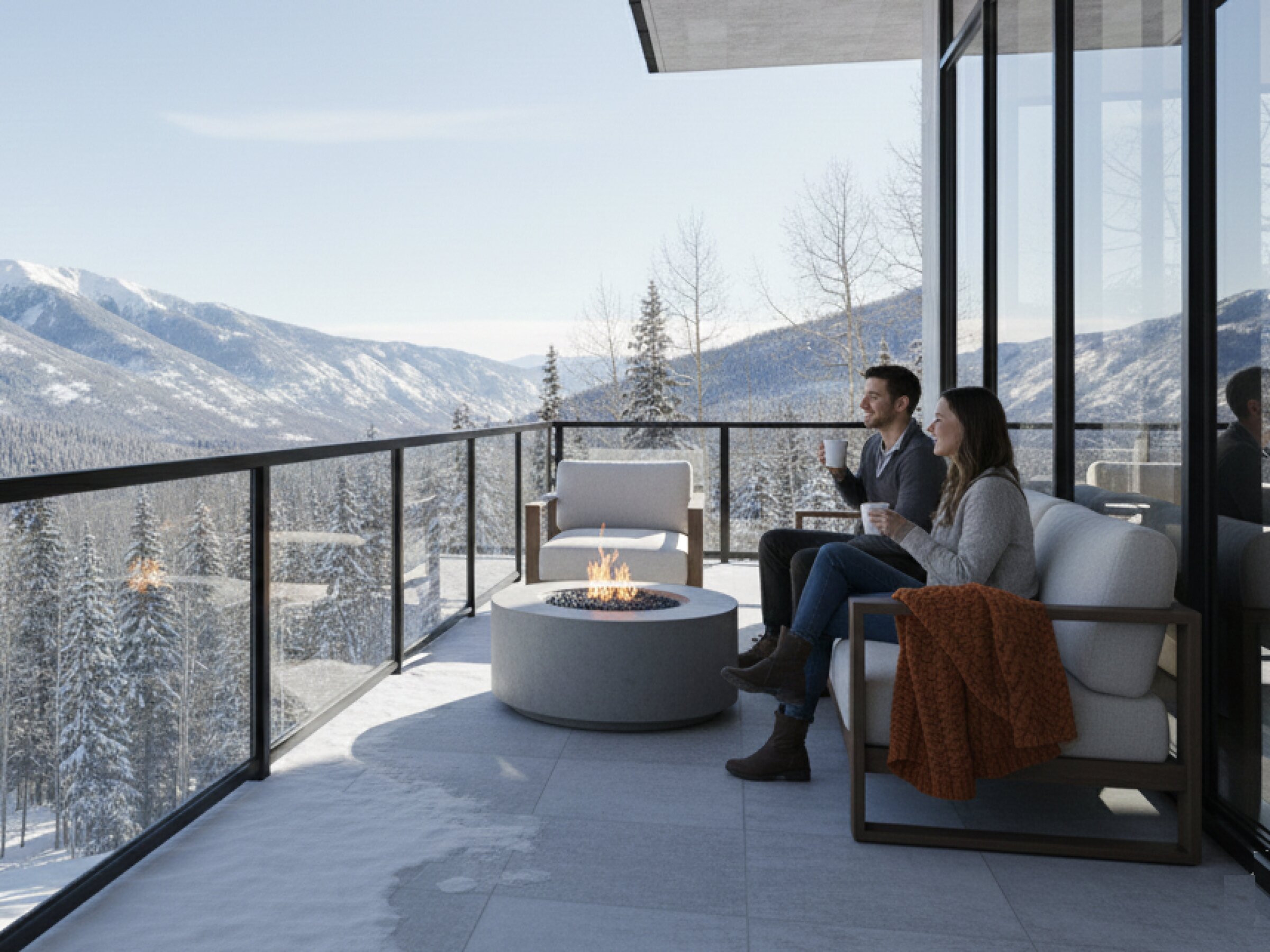
High-Altitude Engineering
High ground snow load, hard freeze-thaw, and high-altitude UV that ages sealants and gaskets faster than the same products age at sea level. Valley winds funnel along the corridor, which is precisely why glass wind screens are a signature local product: they cut the wind on a terrace without touching the view of Bald Mountain.
Recommended Systems for Sun Valley
Mountain installations face elevated UV intensity (25-40% higher than sea level), extreme temperature swings, heavy snow loads, and in some locations seismic activity. INFINITYGLASS alpine specifications include UV-stabilized sealants, freeze-resistant anchoring, and snow-shedding base shoe designs that prevent ice accumulation.
Boundless Frameless Railing
Engineered for Sun Valley conditions with site-specific calculations and local code compliance.
Learn more →Framed Post Railing
Engineered for Sun Valley conditions with site-specific calculations and local code compliance.
Learn more →High-Wall Enclosure System
Engineered for Sun Valley conditions with site-specific calculations and local code compliance.
Learn more →Popular Projects in Sun Valley
Building Codes & Regulations
Sun Valley permits through the City of Sun Valley as its own jurisdiction within Blaine County, under the Idaho Building Code as adopted by the Idaho Building Code Board, currently the 2018 International Building Code with Idaho amendments, referencing ASCE 7-16 for loads. The number that changes the engineering here is snow: Blaine County and its cities publish local snow-load design criteria that supersede general state values, and mountain-valley figures run several times what a lowland market designs to. A guard or wind screen below a roof edge or on a deck that receives shed and drifted snow carries a surcharge a catalogue product was never rated for. Guards follow IBC Section 1015 at 42 inches minimum, with guard glazing per IBC Section 2407 meeting CPSC 16 CFR Part 1201 Category II or ANSI Z97.1 Class A. Sun Valley and Ketchum are separate permitting authorities with their own amendments; confirm the correct city before submittal.
INFINITYGLASS™ provides PE-stamped engineering drawings for permit submittal in Sun Valley and all Idaho jurisdictions.
| Item | Requirement |
|---|---|
| Jurisdiction warning | City of Ketchum, City of Sun Valley and unincorporated Blaine County are three separate permitting jurisdictions with different amendments |
| Permitting authority | City of Ketchum Planning and Building Department, Building Services Division, via the CommunityConnect portal. Blaine County Building Services for unincorporated areas |
| Governing code | 2018 IBC as amended by the Idaho Building Code Board, adopted under Idaho Code Title 39 Chapter 41. Local amendments at Ketchum Municipal Code Chapter 15.04 and Blaine County Code 7-1-3 |
| Companion codes | 2018 IRC, IECC, IEBC, 2018 ISPSC, IPMC, IFC |
| Guard loads | IBC 1607.8 / 1607.8.1, not 1607.9: 50 lb per linear foot, 200 lb concentrated, 50 lb on infill |
| Guard glazing | Laminated fully tempered or heat-strengthened, CPSC 16 CFR 1201 Category II or ANSI Z97.1 Class A, 1/4 in minimum, safety factor of four |
| Roof live snow loads, unincorporated Blaine County | North Fork to Smiley Creek 150 psf; north of Ketchum to North Fork 125 psf; west of Ketchum to the western end of platted Lower Board Ranch 110 psf; east of Triumph 125 psf; north of Bellevue to south of Ketchum 100 psf; Picabo to south of Bellevue 65 psf; Carey Valley 50 psf |
| Important distinction | These are roof live snow loads, not ground snow loads, and they are not reducible without Building Official approval |
| Deck live load | Blaine County amends Table 1607.1 Item 5: exterior balconies and decks 30 in or more above grade take the roof live snow load where exposed to snow, or the Table 1607.1 value, whichever is greater |
| Snow plus seismic | Blaine County amends IBC 1605.3.1: flat roof snow loads of 30 psf or less need not be combined with seismic; where the flat roof snow load exceeds 30 psf, 35 percent shall be combined with seismic loads |
| Snow hooks | Blaine County 1608.4 requires snow hooks as structural elements to protect pedestrians at exits and to protect glazed roof structures from snow and ice sliding from a roof overhead |
| Frost depth | Foundations to 32 in below finished grade unless an Idaho-licensed engineer seals a different design (Blaine County 1809.5) |
| Pool barrier | 2018 ISPSC as adopted by state and city without amendment |
| Step | Detail |
|---|---|
| Avalanche Zone | Before a permit issues for any structure within Ketchum's Avalanche Zone, the applicant must submit plans signed by an Idaho-licensed engineer certifying the construction will withstand avalanche forces, per the avalanche studies on file with the City. Ketchum publishes an Avalanche Zone Affidavit |
| Exceptions | Remodels to existing non-engineered single-family homes, and additions under 1,200 gross square feet to the same |
| Seal required | Idaho-licensed engineer to deviate from the 32 in frost depth, and stamped calculations may be requested for the snow-plus-seismic combination |
| Blaine County timeline | About four weeks from drop-off of a completed application during the March to October building season |
| Ketchum process | Zoning and building review run in-house, in order of submission, simultaneously where practical |
| Dark sky | Ketchum Municipal Code Chapter 17.132, Dark Skies, adopted June 1999 and amended 2017. Ketchum was the first International Dark Sky Community designated in Idaho and sits within the Central Idaho Dark Sky Reserve |
The code here has a provision written specifically to stop sliding snow from destroying glass
Sun Valley is the most structurally demanding market in our footprint and the reasons are unusually concrete.
Blaine County Section 1608.4 requires snow hooks, and the code states their purpose directly: to protect pedestrians at exits and similar areas, and to protect glazed roof structures from snow and ice sliding from a roof overhead. It is rare for a building code to name glass protection as the object of a structural requirement. Here it does, and it tells you what the failure mode in this market actually is.
The numbers behind that are equally specific. Unincorporated Blaine County sets site-specific roof live snow loads rather than a single figure, ranging from 50 psf in the Carey Valley to 150 psf from North Fork to Smiley Creek, with the Ketchum corridor at 100 to 125 psf. These are not reducible without the Building Official's approval. And the county amends Table 1607.1 so that exterior balconies and decks 30 inches or more above grade carry the roof live snow load where exposed to snow, or the table value, whichever is greater. Near Ketchum that means a deck framed for 100 psf or more, which sets the substrate a glass guard anchors into long before the guard itself is designed.
A further amendment combines the two hazards: where the flat roof snow load exceeds 30 psf, 35 percent of it must be combined with seismic loads. Given that local snow loads are far above that threshold, this combination is live on essentially every project here, and it is a case that simply does not arise in lower-snow seismic markets.
Two more gates worth planning around. Within Ketchum's Avalanche Zone, no permit issues until an Idaho-licensed engineer certifies in signed plans that the construction will withstand avalanche forces per the studies on file with the City. And Ketchum's dark-sky ordinance, Chapter 17.132, governs exterior lighting rather than glazing, but it shapes how a deck or rail is lit. A glass guard is a low-glare alternative to a lit solid barrier, which is a genuine advantage in a dark-sky community.
Sun Valley and Ketchum submarkets we serve
Warm Springs at the base of Bald Mountain's Warm Springs lifts. Elkhorn, Sun Valley's largest residential area, built around the Elkhorn golf course. Sun Valley Village and Dollar Mountain for resort and hospitality. Downtown Ketchum for the walkable retail and restaurant core. Northwood for the luxury estate segment.
Frequently Asked Questions: Glass Fencing in Sun Valley
What building code applies to glass railings in Sun Valley?
The Idaho Building Code, currently the 2018 IBC with Idaho amendments, administered by the City of Sun Valley as its own jurisdiction. Sun Valley and Ketchum permit separately.
Why do snow loads dominate railing design here?
Blaine County publishes local snow-load criteria that supersede state values, and decks and terraces receive shed and drifted snow. Guards and wind screens are engineered for that surcharge, not just wind and occupant loads.
How tall must a glass guard be in Sun Valley?
At least 42 inches from the walking surface per IBC Section 1015 for most occupancies.
What glass is required in a guard?
Laminated glass constructed of fully tempered or heat-strengthened glass meeting IBC Section 2407 and either CPSC 16 CFR Part 1201 Category II or ANSI Z97.1 Class A.
Do glass wind screens work on mountain terraces?
Yes, they are one of the most common local applications: they block valley winds and extend the outdoor season while preserving the mountain view. They are engineered to the same load cases as guards when they protect an edge.
Do you provide stamped engineering for Blaine County permits?
Yes. Project-specific PE-stamped calculations are prepared to the local snow-load criteria and the applicable IBC load cases.