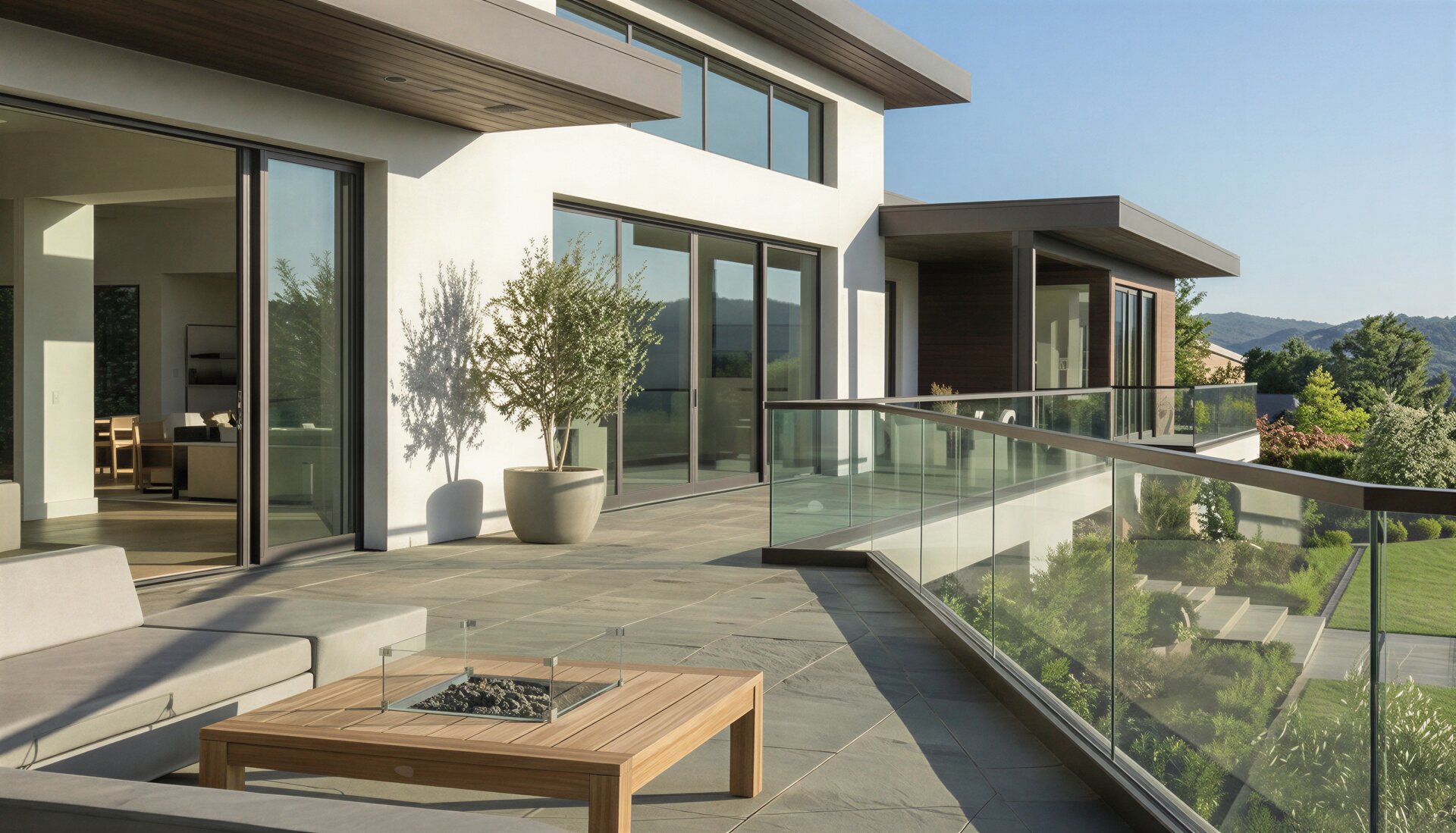
Four-Season Performance
Atlanta's humid subtropical climate brings long 90 F-plus summers, mild winters with occasional ice events, intense spring pollen, and strong UV. The practical implications: low-iron glass keeps clarity high in bright southern sun, an easy-clean coating pays for itself in pollen season (our EnduroShield treatment reduces cleaning effort by about 90 percent), and UV-stable hardware finishes hold up year-round. Design wind speeds run roughly 105 to 115 mph (3-second gust, ASCE 7-16, Risk Category II) for thunderstorm and remnant-tropical-system exposure, well below coastal hurricane provisions, and freeze-thaw detailing covers the occasional winter ice event.
Recommended Systems for Atlanta
Four-season climates require glass systems engineered for the full temperature range with freeze-thaw resistant mounting, proper drainage provisions, and hardware rated for both summer heat and winter cold. INFINITYGLASS temperate-climate specifications balance durability with cost-efficiency for moderate engineering requirements.
Boundless Frameless Railing
Engineered for Atlanta conditions with site-specific calculations and local code compliance.
Learn more →Framed Post Railing
Engineered for Atlanta conditions with site-specific calculations and local code compliance.
Learn more →High-Wall Enclosure System
Engineered for Atlanta conditions with site-specific calculations and local code compliance.
Learn more →INFINITYFLEX Modular Partition
Engineered for Atlanta conditions with site-specific calculations and local code compliance.
Learn more →Popular Projects in Atlanta
Building Codes & Regulations
Atlanta permits through the City of Atlanta Department of City Planning, Office of Buildings, under the Georgia State Minimum Standard Codes: as of January 1, 2026 that means the 2024 International Building Code with Georgia Amendments (projects permitted earlier are vested under the prior 2018-based editions). Glass used in a guard must be laminated tempered or laminated heat-strengthened glass with a factor of safety of four (IBC Section 2407), certified to CPSC 16 CFR 1201 Category II or ANSI Z97.1 Class A, and guards must resist the code's 50 lb per linear foot and 200 lb concentrated loads. Georgia also adopted the 2024 International Swimming Pool and Spa Code with state amendments, so residential pool barriers require a minimum 48-inch height with self-closing, self-latching gates and no openings that pass a 4-inch sphere. Seismic loading is low in the Atlanta metro; wind and thermal movement govern the engineering, with design wind speeds roughly 105 to 115 mph (3-second gust, ASCE 7-16, Risk Category II) covering the region's thunderstorm exposure.
INFINITYGLASS™ provides PE-stamped engineering drawings for permit submittal in Atlanta and all Georgia jurisdictions. Georgia Building Codes Guide →
| Item | Requirement |
|---|---|
| Permitting authority | City of Atlanta Department of City Planning, Office of Buildings |
| Governing code | 2024 International Building Code with Georgia Amendments, mandatory state minimum standard, effective 2026-01-01 |
| Companion codes | 2024 IRC, IPC, IMC, IFGC, IFC and ISPSC with Georgia Amendments; 2023 NEC |
| Energy | 2015 IECC with Georgia Supplements and Amendments, notably older than the rest of the code set |
| Guard loads | IBC 1607.9: 200 lb concentrated (1607.9.1.1), 50 lb per linear foot along the top rail, non-concurrent; 50 lb on an area not exceeding 12 in by 12 in for infill (1607.9.1.2) |
| Guard glazing | The 2024 IBC replaced the factor-of-four rule. IBC 2407.1.1 now caps calculated stress at 3,000 psi for heat-strengthened glass and 6,000 psi for fully tempered glass |
| Safety glazing | CPSC 16 CFR 1201 Category II or ANSI Z97.1 Class A |
| Wind | ASCE 7-22 per the 2024 IBC basis. Georgia Amendment IBC-2024-45 revises Section 1609.1.1, determination of wind loads |
| Governing hazard | Wind and severe thunderstorm |
| Pool barrier | 2024 ISPSC with Georgia Amendments: 48 in minimum, 4 in sphere rule, self-closing and self-latching gates, no climbable features |
| Step | Detail |
|---|---|
| Guard engineering | Deferred submittal under IBC 107.3.4.1 |
| Seal required | Georgia-licensed PE or Registered Architect on commercial construction documents |
| Historic and design | Certificate of Appropriateness from the Atlanta Urban Design Commission for exterior work in Landmark, Historic or Conservation districts and on individually designated properties |
| Review tiers | Some scopes are staff-reviewed by the Historic Preservation Studio; others require a public hearing |
| Important | A COA does not replace the building permit. Both are required |
| Transition | The Office of Buildings aligned with the 2024 codes for permit submissions from 2026-01-01 |
Atlanta is on the 2024 IBC, and the glass guard rule you know was deleted
Georgia adopted the 2024 IBC as a mandatory state minimum standard effective 2026-01-01, which puts Atlanta ahead of most of the country and makes a lot of published guidance stale.
The change that matters most to glass guards is specific. For three code cycles, glass in handrails and guards was designed using a factor of safety of four against the mean modulus of rupture. The 2024 IBC deleted that language. Section 2407.1.1 now states the requirement directly as a stress cap: calculated stresses under the Section 1607.9 loads are limited to 3,000 psi for heat-strengthened glass and 6,000 psi for fully tempered glass. The effective safety margin is the same, because those are one quarter of the industry mean rupture values. What changed is that the long-standing ambiguity about how to apply the factor of four is gone, and the submittal now shows a stress check against a number rather than a derivation.
Two further 2024 changes affect glass enclosures and partitions. Section 2406.1 was clarified so that every pane in a multipane assembly in a hazardous location must be safety glazing. And the outboard-pane threshold in 2406.4.3 Exception 3 dropped from 25 ft to 8 ft above grade or an adjacent walking surface, which widens the range of installations that need safety glazing on the outboard lite.
Atlanta submarkets we serve
Buckhead and Midtown for high-rise residential and office terraces. West Midtown and the Upper Westside for adaptive reuse and restaurant patios. The Old Fourth Ward and the Ponce City Market corridor, where Urban Design Commission review is common. Atlantic Station for mixed-use. The Battery Atlanta at Cumberland and Avalon in Alpharetta for hospitality and retail.
Frequently Asked Questions: Glass Fencing in Atlanta
What building code applies to glass railings in Atlanta?
The Georgia State Minimum Standard Codes apply statewide: as of January 1, 2026 that is the 2024 International Building Code with Georgia Amendments, administered locally by the City of Atlanta Office of Buildings. We provide PE-stamped drawings for permit submittal.
How tall does a pool fence need to be in Atlanta?
Georgia adopted the 2024 International Swimming Pool and Spa Code with state amendments, which requires residential pool barriers at least 48 inches high with self-closing, self-latching gates and no openings that pass a 4-inch sphere. Frameless glass meets this while keeping the pool area visually open.
Did Georgia's 2026 code update change glass railing requirements?
The load and glazing fundamentals carry over: glass in guards must be laminated safety glazing with a factor of safety of four (IBC Section 2407) and guards must resist 50 lb per linear foot and 200 lb concentrated loads. Our engineering is prepared against the current adopted edition.
How does glass fencing handle Atlanta pollen season?
Glass rinses clean far more easily than mesh or ornamental metal, and our EnduroShield easy-clean treatment reduces cleaning effort by about 90 percent, which matters most in the heavy spring pollen weeks.
Does Atlanta need hurricane-rated glass fencing?
No. Atlanta sits inland of Georgia's coastal high-wind zones, so standard provisions apply, with design wind speeds roughly 105 to 115 mph (ASCE 7-16, Risk Category II) for thunderstorm exposure. Coastal projects toward Savannah are a different engineering case, which we also support.
Does INFINITYGLASS supply Atlanta multifamily and commercial projects?
Yes. We supply factory-direct guardrail, fencing, and partition systems for multifamily and commercial projects across the metro, with PE-stamped engineering and submittal-ready documentation for developers and GCs.