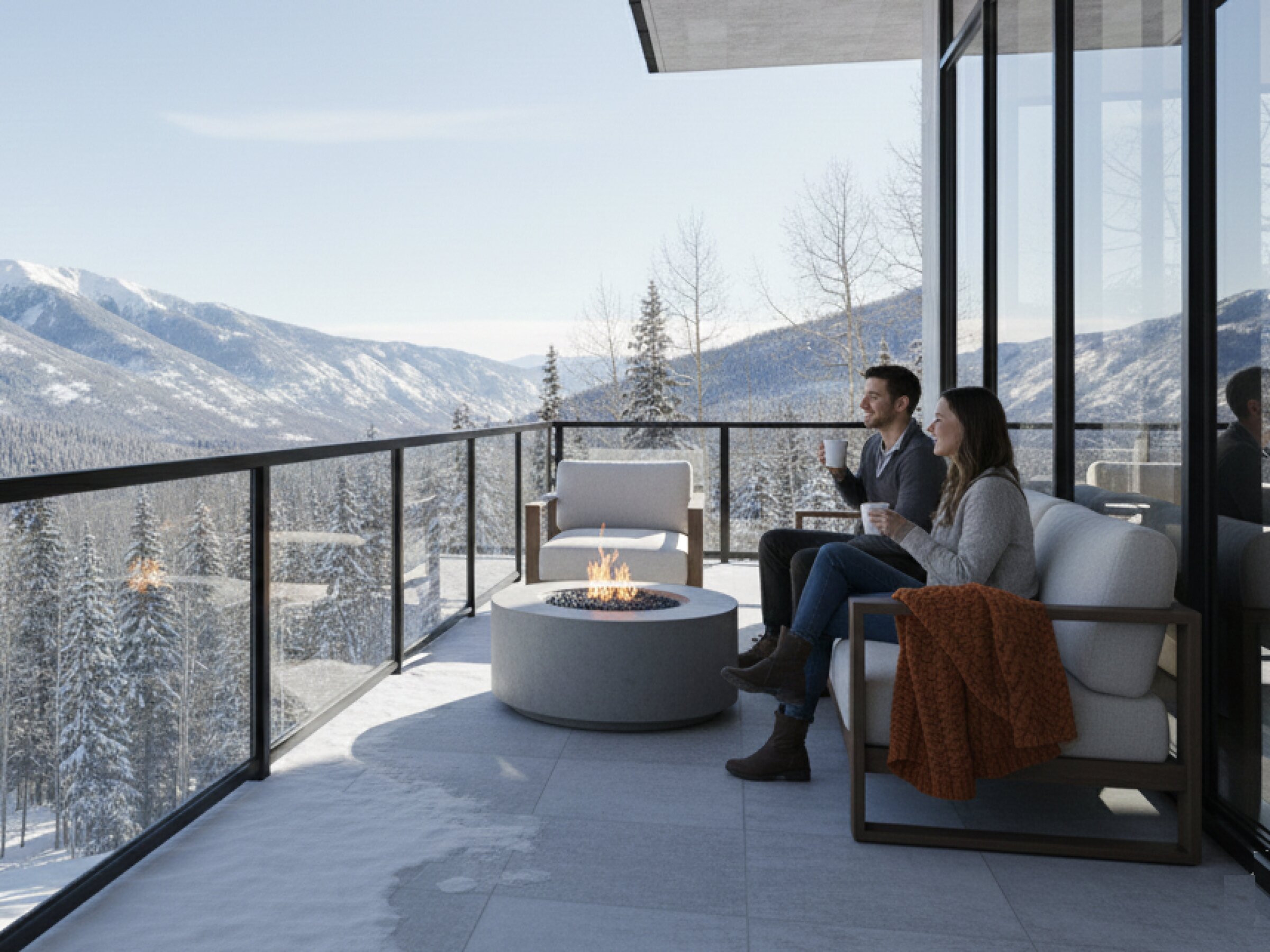
Cold-Climate Engineering
Chicago swings roughly 0 F to 95 F with lake-effect wind and heavy winter salt use, so the engineering priorities are freeze-thaw durability, wind, and corrosion: mounting details are designed to drain rather than trap water (trapped water that freezes is what stresses hardware and concrete, not the glass itself), design wind speeds of roughly 105 to 110 mph (3-second gust, ASCE 7-16, Risk Category II) rise with exposure on lakefront and rooftop sites, and street-level installations get 316-grade stainless hardware against de-icing salt. Tempered laminated glass is unaffected by cold and doubles as a wind screen: on Chicago roof decks a glass windbreak keeps the skyline view while cutting the wind that makes a terrace unusable.
Recommended Systems for Chicago
Extreme cold requires specialized engineering: 316 stainless steel hardware rated to -40°F, EPDM gaskets that maintain flexibility at extreme cold, drainage provisions that prevent ice buildup and frost heaving, and de-icing salt resistant finishes. INFINITYGLASS cold-climate specifications address snow accumulation at base shoes and thermal contraction stress on mounting points.
Boundless Frameless Railing
Engineered for Chicago conditions with site-specific calculations and local code compliance.
Learn more →Framed Post Railing
Engineered for Chicago conditions with site-specific calculations and local code compliance.
Learn more →High-Wall Enclosure System
Engineered for Chicago conditions with site-specific calculations and local code compliance.
Learn more →INFINITYFLEX Modular Partition
Engineered for Chicago conditions with site-specific calculations and local code compliance.
Learn more →Popular Projects in Chicago
Building Codes & Regulations
Chicago is one of the few US cities that writes its own construction code rather than adopting a state code: projects follow the Chicago Construction Codes, whose building provisions (Title 14B, the 2019 Chicago Building Code) are based on the 2018 IBC with substantial local amendments, administered by the Chicago Department of Buildings. The glass-guard fundamentals mirror the model code: laminated tempered or laminated heat-strengthened glass with a factor of safety of four (per IBC Section 2407 as carried into 14B), certified to CPSC 16 CFR 1201 Category II or ANSI Z97.1 Class A, with guards resisting 50 lb per linear foot and 200 lb concentrated loads. Pool barriers are stricter than the Illinois state minimum of 42 inches: Chicago requires pools deeper than 4 feet to be fully enclosed by a barrier at least 5 feet high with self-closing, self-latching gates and an audible alarm that sounds when the gate opens. Design wind speeds run roughly 105 to 110 mph (3-second gust, ASCE 7-16, Risk Category II), with exposed lakefront and high-rise terrace sites engineered for their actual exposure category; seismic loading is negligible.
INFINITYGLASS™ provides PE-stamped engineering drawings for permit submittal in Chicago and all Illinois jurisdictions. Illinois Building Codes Guide →
Frequently Asked Questions: Glass Fencing in Chicago
What building code applies to glass railings in Chicago?
The Chicago Construction Codes apply, not a statewide Illinois code: building provisions are Title 14B (the 2019 Chicago Building Code, based on the 2018 IBC with local amendments), administered by the Chicago Department of Buildings. We provide PE-stamped drawings prepared for Chicago submittal.
How tall does a pool fence need to be in Chicago?
Chicago is stricter than the Illinois state minimum of 42 inches: pools deeper than 4 feet must be fully enclosed by a barrier at least 5 feet high with self-closing, self-latching gates and an audible gate alarm. Our frameless pool fencing is built to the 60-inch standard this requires.
Can a glass railing survive a Chicago winter?
Yes. Tempered laminated glass is unaffected by cold; the engineering focus is drainage detailing so water cannot pool and freeze at connections, plus 316-grade stainless hardware where winter salt spray reaches street-level installations.
Do rooftop decks in Chicago need special wind engineering?
Exposed rooftop and lakefront sites are engineered for their actual exposure category above the roughly 105 to 110 mph baseline (3-second gust, ASCE 7-16, Risk Category II). A glass wind screen is often the reason the deck works at all: it blocks wind without blocking the skyline.
Why laminated glass for guards and railings?
The Chicago code carries the model-code requirement: glass in guards must be laminated tempered or laminated heat-strengthened glass with a factor of safety of four. Lamination holds the panel together even if a lite breaks.
Does INFINITYGLASS serve Chicago high-rise and multifamily projects?
Yes. We supply factory-direct guardrail, wind-screen, and partition systems for towers, multifamily, and commercial projects across the metro, with PE-stamped engineering and submittal-ready documentation.