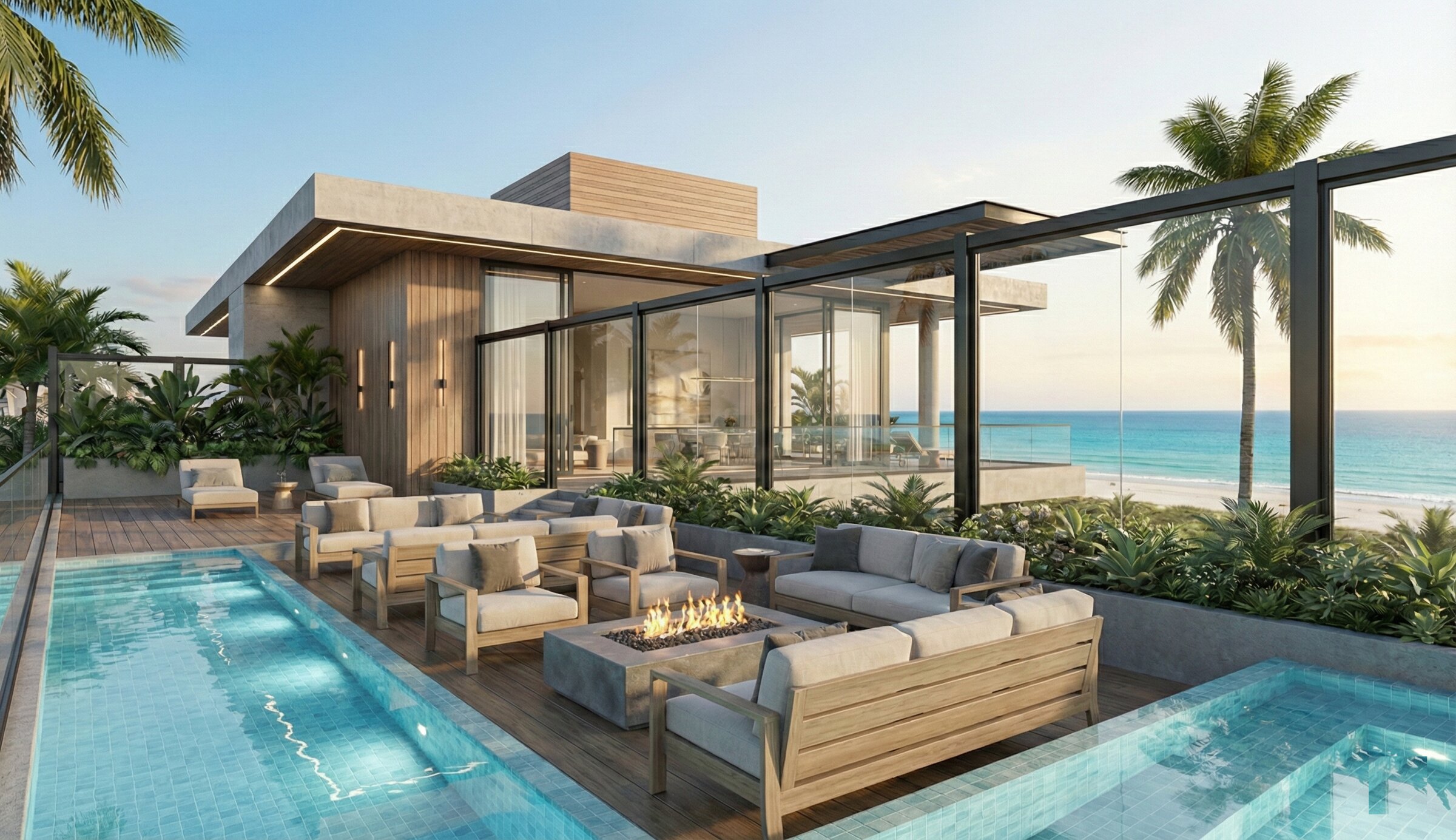
Coastal Corrosion Protection
A barrier island is a corrosion environment first: salt air reaches every exposed fastener on the island, not just oceanfront lots. 316 or duplex stainless hardware, sealed base shoes, marine-grade finishes and laminated interlayers selected for coastal durability are the baseline specification, with hurricane-season wind pressures setting the structural sizing.
Recommended Systems for Hilton Head Island
Salt air exposure at this coastal location requires marine-grade materials throughout every glass installation. INFINITYGLASS specifies 316 stainless steel hardware, marine-grade anodized aluminum channels, and UV-resistant sealants that withstand constant salt spray without degradation. All finishes are rated for coastal exposure.
Boundless Frameless Railing
Engineered for Hilton Head Island conditions with site-specific calculations and local code compliance.
Learn more →Framed Post Railing
Engineered for Hilton Head Island conditions with site-specific calculations and local code compliance.
Learn more →High-Wall Enclosure System
Engineered for Hilton Head Island conditions with site-specific calculations and local code compliance.
Learn more →Popular Projects in Hilton Head Island
Building Codes & Regulations
Hilton Head Island permits through the Town of Hilton Head Island under the South Carolina Building Code suite adopted by the South Carolina Building Codes Council, currently based on the 2021 International Building Code with state modifications. Wind is the governing load: coastal Beaufort County design wind speeds run roughly 140 to 150 mph for Risk Category II structures under ASCE 7-16, and barrier-island sites near open water fall into higher exposure categories, so a glass guard or fence here is engineered to project-specific wind pressures rather than specified from a catalogue rating. Guards follow IBC Section 1015 at 42 inches minimum, with guard glazing per IBC Section 2407 meeting CPSC 16 CFR Part 1201 Category II or ANSI Z97.1 Class A.
INFINITYGLASS™ provides PE-stamped engineering drawings for permit submittal in Hilton Head Island and all South Carolina jurisdictions. South Carolina Building Codes Guide →
| Item | Requirement |
|---|---|
| Permitting authority | Town of Hilton Head Island Community Development Department, Building Division, 1 Town Center Court. Permits via the Building and Development Citizen Self Service portal |
| Governing code | 2021 International Building Code, effective 2023-01-01, with South Carolina amendments. Adopted statewide by the SC Building Codes Council on 2021-10-06 |
| Companion codes | 2021 IRC, IFC, IPC, IMC, IFGC, 2021 International Swimming Pool and Spa Code, 2020 NEC |
| Energy | 2009 IECC, notably older than the rest of the adopted set |
| Guard loads | IBC 1607.9: 50 lb per linear foot, 200 lb concentrated |
| Guard glazing | Laminated fully tempered or heat-strengthened, CPSC 16 CFR 1201 Category II or ANSI Z97.1 Class A, safety factor of four per 2407.1.1 |
| Wind standard | ASCE 7-16 per the 2021 IBC basis |
| Hurricane and debris | Hurricane-prone region and windborne-debris region. Coastal South Carolina commercial glazing is tested to ASTM E1886 and E1996, the non-Florida impact standard pair |
| Seismic | Live consideration. The island sits in the Charleston seismic zone, legacy of the 1886 Charleston earthquake |
| Pool barrier | 2021 ISPSC: 48 in minimum above grade on the side facing away from the pool, maintained around the entire perimeter and for 3 ft measured horizontally outward |
| Plan review | Within 20 business days of a complete application |
| Step | Detail |
|---|---|
| Design Review Board | Formal Corridor Review process, in addition to the building permit |
| Minor Corridor Review | Submit anytime; staff review typically within five days |
| Major Corridor Review | Applications due two weeks before the DRB meeting |
| What triggers review | Location-based: major and minor roads, water or marsh frontage, resort areas, and the Sea Pines Circle and Coligny Circle areas |
| What is in scope | Changes to landscaping, walls, fences, pavement and outdoor lighting are subject to design review, which puts an exterior glass fence or guard directly in scope |
| Governing ordinance | Land Management Ordinance (LMO) |
| Sea turtle protection | Lights visible from the beach shielded or off dusk to dawn, May 1 through October 31. Windows facing the beach must be covered with draperies or shade screens. Outside lights off at 10:00 p.m. if the building is visible from the beach |
Hurricane wind and seismic detailing in the same assembly, which is genuinely unusual
Most coastal markets are a wind problem. Most seismic markets are inland. Hilton Head is both, and that combination is rare enough that it changes how a glass guard gets detailed.
On the wind side the island is in a hurricane-prone region and a windborne-debris region, and coastal South Carolina glazing is tested to ASTM E1886 and E1996 rather than the Florida TAS series. On the seismic side, Beaufort County sits in the Charleston seismic zone, the legacy of the 1886 Charleston earthquake, which remains the most significant seismic event recorded in the eastern United States. A guard assembly here has to satisfy both the impact and pressure case and the seismic detailing case, where a Florida barrier-island project satisfies only the first.
The second Hilton Head reality is that design review is not a formality and it explicitly reaches fences. The Town's Design Review Board runs a Corridor Review process triggered by location, including water and marsh frontage, and the Land Management Ordinance places changes to walls, fences, pavement and outdoor lighting squarely in scope. Minor Corridor Review is fast, usually about five days at staff level. Major Corridor Review is scheduled against a board meeting with a two-week submittal deadline.
Third, and directly relevant to glass selection on oceanfront property: the island's sea turtle protection rules require that windows facing the beach be covered with draperies or shade screens during nesting season, with beach-visible lighting shielded or extinguished from May 1 through October 31. That is a real constraint on how oceanfront glazing performs and how it is specified.
Hilton Head submarkets we serve
Sea Pines for upscale residential and seaside resort work. Palmetto Dunes, 2,000 acres of mid-island oceanfront with three miles of beach and multi-phase neighborhood renovations underway. Shelter Cove Harbour and Marina for waterfront dining and retail. Coligny and South Forest Beach at the south end, where Corridor Review is triggered by location. Bluffton and Palmetto Bluff off-island for the luxury adjacency.
Frequently Asked Questions: Glass Fencing in Hilton Head Island
What building code applies to glass railings on Hilton Head Island?
The South Carolina Building Code suite, currently based on the 2021 IBC with state modifications, administered by the Town of Hilton Head Island.
What wind speeds does a Hilton Head glass fence need to meet?
Coastal Beaufort County design values run roughly 140 to 150 mph for Risk Category II under ASCE 7-16, with exposure category determined by the site. Panels and anchorage are engineered to the project's actual pressures.
Do community Architectural Review Boards need to approve a glass railing?
In most of the island's planned communities, yes, before town permitting. Low-profile glass systems tend to fare well under ARB view and aesthetic standards.
How tall must a glass guard be on Hilton Head?
At least 42 inches from the walking surface per IBC Section 1015 for most occupancies.
How does salt air affect the system?
It drives hardware and finish selection island-wide: 316 or duplex stainless, sealed base details and marine-grade finishes are what prevent staining and corrosion.
Do you provide stamped engineering for Hilton Head permits?
Yes. Project-specific PE-stamped wind calculations are prepared to ASCE 7 for the site's exposure and risk category.