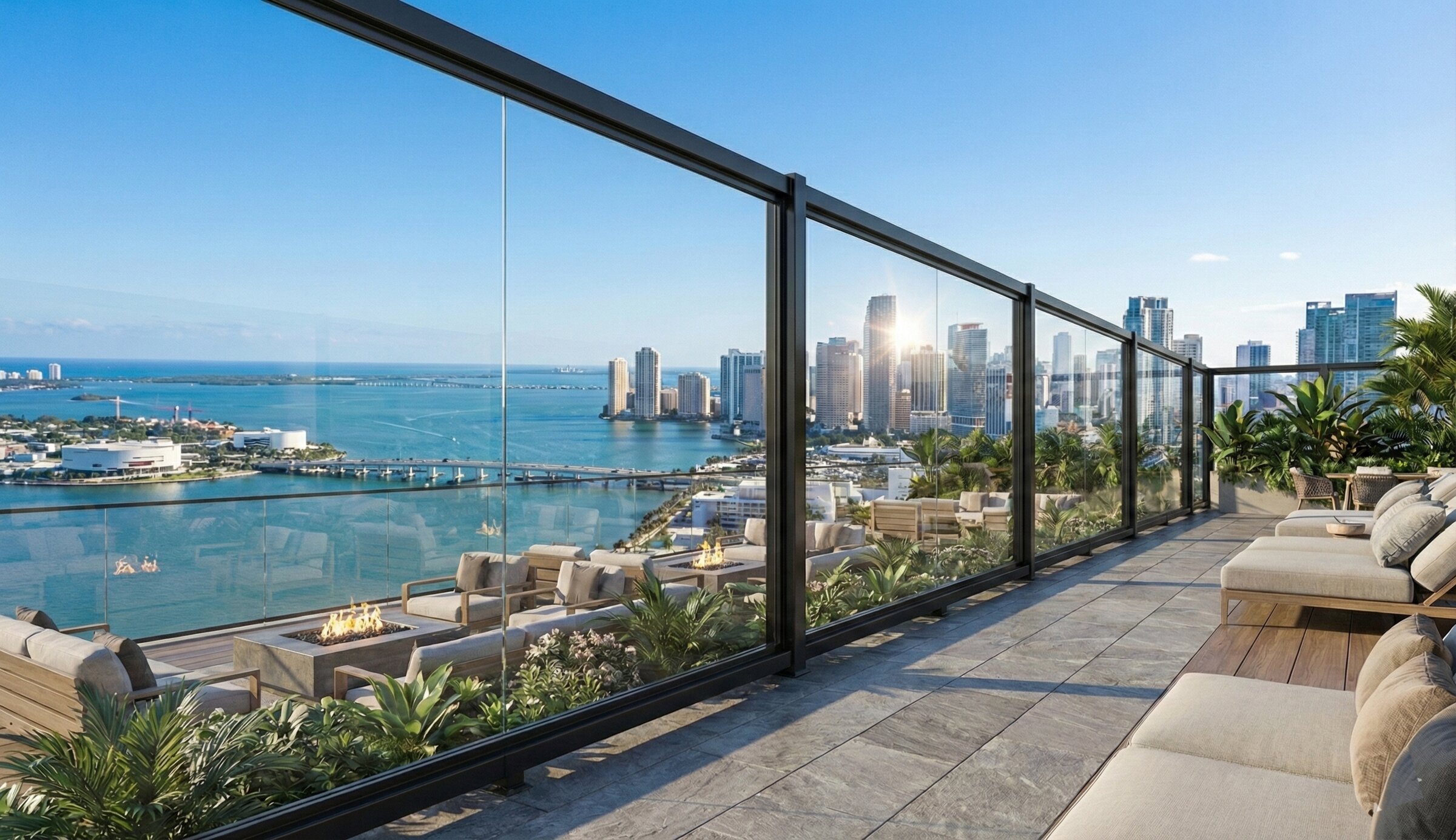
Hurricane-Zone Engineering
Houston is hot, humid, and storm-exposed: summers run 95 F-plus with heavy UV, and the Gulf brings hurricane-season wind and rain. The engineering response is direct: design wind speeds of roughly 107 to 120 mph (3-second gust, ASCE 7-16, Risk Category II) rise toward the coast, laminated glass makeups are specified to the site wind speed, and drainage detailing sheds the region's intense rain events. Humidity and UV favor 316-grade stainless hardware and UV-stable finishes, and an easy-clean coating (our EnduroShield treatment reduces cleaning effort by about 90 percent) keeps glass clear through pollen and storm seasons. Glass does not rot, warp, or rust, which is precisely what Houston's climate does to wood and iron fencing.
Recommended Systems for Houston
This location falls within a hurricane-prone zone requiring impact-rated glass systems. All INFINITYGLASS exterior installations use laminated tempered glass with SGP interlayers, passing ASTM E1996 large missile impact testing and cyclic pressure protocols. Systems are engineered to meet or exceed local wind speed requirements with PE-stamped structural calculations.
High-Wall Enclosure System
Engineered for Houston conditions with site-specific calculations and local code compliance.
Learn more →Boundless Frameless Railing
Engineered for Houston conditions with site-specific calculations and local code compliance.
Learn more →Framed Post Railing
Engineered for Houston conditions with site-specific calculations and local code compliance.
Learn more →INFINITYFLEX Modular Partition
Engineered for Houston conditions with site-specific calculations and local code compliance.
Learn more →Popular Projects in Houston
Building Codes & Regulations
Houston permits through the Houston Permitting Center under the city's locally adopted 2021 International Building Code and 2021 IRC with Houston amendments, administered by Houston Public Works (Texas has no statewide commercial code adoption, so the city's adoption governs). Glass used in a guard must be laminated tempered or laminated heat-strengthened glass with a factor of safety of four (IBC Section 2407), certified to CPSC 16 CFR 1201 Category II or ANSI Z97.1 Class A, and guards must resist the code's 50 lb per linear foot and 200 lb concentrated loads. Residential pool barriers require a minimum 48-inch height with self-closing, self-latching gates under the adopted residential provisions. Wind governs the engineering: design wind speeds run roughly 107 to 120 mph (3-second gust, ASCE 7-16, Risk Category II) across the metro and rise toward the coast, where windborne-debris provisions begin to apply; seismic loading is negligible. Our hurricane-region engineering and laminated makeups are specified to the actual site wind speed.
INFINITYGLASS™ provides PE-stamped engineering drawings for permit submittal in Houston and all Texas jurisdictions. Texas Building Codes Guide →
| Item | Requirement |
|---|---|
| Permitting authority | Houston Public Works, Building Code Enforcement, at the Houston Permitting Center |
| Governing code | 2021 Houston Construction Code, the 2021 IBC with Houston amendments, adopted by Ordinance 2023-907, effective 2024-01-01 |
| State context | Texas has no statewide commercial building code. Houston enforces locally adopted codes by ordinance |
| Guard loads | IBC 1607.9: 50 lb per linear foot, 200 lb concentrated |
| Guard glazing | Laminated fully tempered or heat-strengthened, safety factor of four per IBC 2407.1.1 |
| Wind standard | Houston enforces ASCE 7-22 while sitting on the 2021 IBC, and requires the basic wind speed to be determined site-specifically from the ASCE 7 Hazard Tool. The city publishes no fixed design wind speed |
| Exposure | Category B is the general Houston default, varying by location |
| Seismic | Seismic Design Category A, stated on the city's own design criteria form. Wind and expansive soil govern, not seismic |
| Soil | Expansive, per the same city form |
| Pool barrier | Texas Health and Safety Code Chapter 757 sets 48 in for multiunit rental complexes and POA pools; Houston Code of Ordinances Chapter 43 requires a 4 ft enclosure with self-closing, self-latching gates |
| Step | Detail |
|---|---|
| Guard engineering | Deferred submittal under IBC 107.3.4.1, prior building-official approval required |
| Seal required | Texas-licensed PE under the Texas Engineering Practice Act |
| Commercial plan review | Published service level of 15 business days; fee-based expedited review available |
| Zoning | None. Houston has no zoning. |
| Historic | Certificate of Appropriateness from the Houston Archaeological and Historical Commission for exterior work on landmarks, protected landmarks and contributing buildings in historic districts, under Code Sec. 33-241 |
| Energy | 2021 IECC or ASHRAE 90.1-2019, Climate Zone 2-A |
Houston has no zoning, and that is not the same as no review
Houston is the largest American city without zoning, and that genuinely removes a constraint most markets impose. What it does not remove is historic review. Exterior work on a designated landmark, a protected landmark or a contributing building inside a historic district requires a Certificate of Appropriateness from the Houston Archaeological and Historical Commission, filed through the Historic Preservation Tracker and administered by Planning and Development. Work done without one is subject to fines and restoration orders. A glass guard on a River Oaks or Heights contributing structure is in scope even though the parcel has no zoning designation at all.
The second Houston-specific point is a genuine technical quirk worth knowing before you design. Houston enforces ASCE 7-22 even though the city is on the 2021 IBC, which references ASCE 7-16. The city publishes no fixed design wind speed and directs designers to the ASCE 7 Hazard Tool for a site-specific value. Anyone who carries a regional rule of thumb into a Houston submittal is working from the wrong standard and an obsolete number.
Houston submarkets we serve
River Oaks District and Uptown Galleria for luxury retail and residential. The Museum District, Midtown and Montrose for mid-rise multifamily and hospitality. The Heights and EaDo for adaptive reuse. The Buffalo Bayou and Allen Parkway corridor for view railings. Memorial City and the Energy Corridor for corporate campus interiors and amenity decks.
Frequently Asked Questions: Glass Fencing in Houston
What building code applies to glass railings in Houston?
Houston's locally adopted 2021 International Building Code with city amendments applies, permitted through the Houston Permitting Center and administered by Houston Public Works. We provide PE-stamped drawings for submittal.
How tall does a pool fence need to be in Houston?
Residential pool barriers require a minimum 48-inch height with self-closing, self-latching gates under the adopted residential provisions. Frameless glass meets the requirement while keeping the pool area visually open.
Can glass fencing survive a Houston hurricane season?
Glass fencing here is engineered to the actual site wind speed, roughly 107 to 120 mph across the metro (3-second gust, ASCE 7-16, Risk Category II) and higher toward the coast, using laminated makeups that hold together under load. Windborne-debris provisions apply nearer the shoreline, and we engineer to them where required.
How does glass handle Houston humidity compared with wood or iron?
Glass does not rot, warp, or rust. Humidity and UV are hardware questions, so we specify 316-grade stainless hardware and UV-stable finishes, plus an easy-clean coating that reduces maintenance by about 90 percent.
Why laminated glass for guards and railings?
IBC Section 2407 requires glass in guards to be laminated tempered or laminated heat-strengthened glass with a factor of safety of four. Lamination holds the panel together even if a lite breaks, which matters most in a wind-driven-debris region.
Does INFINITYGLASS serve the greater Houston area?
Yes. We ship factory-direct throughout Harris County and the surrounding metro, from the Heights to Sugar Land to The Woodlands, with PE-stamped engineering matched to each site's wind exposure.