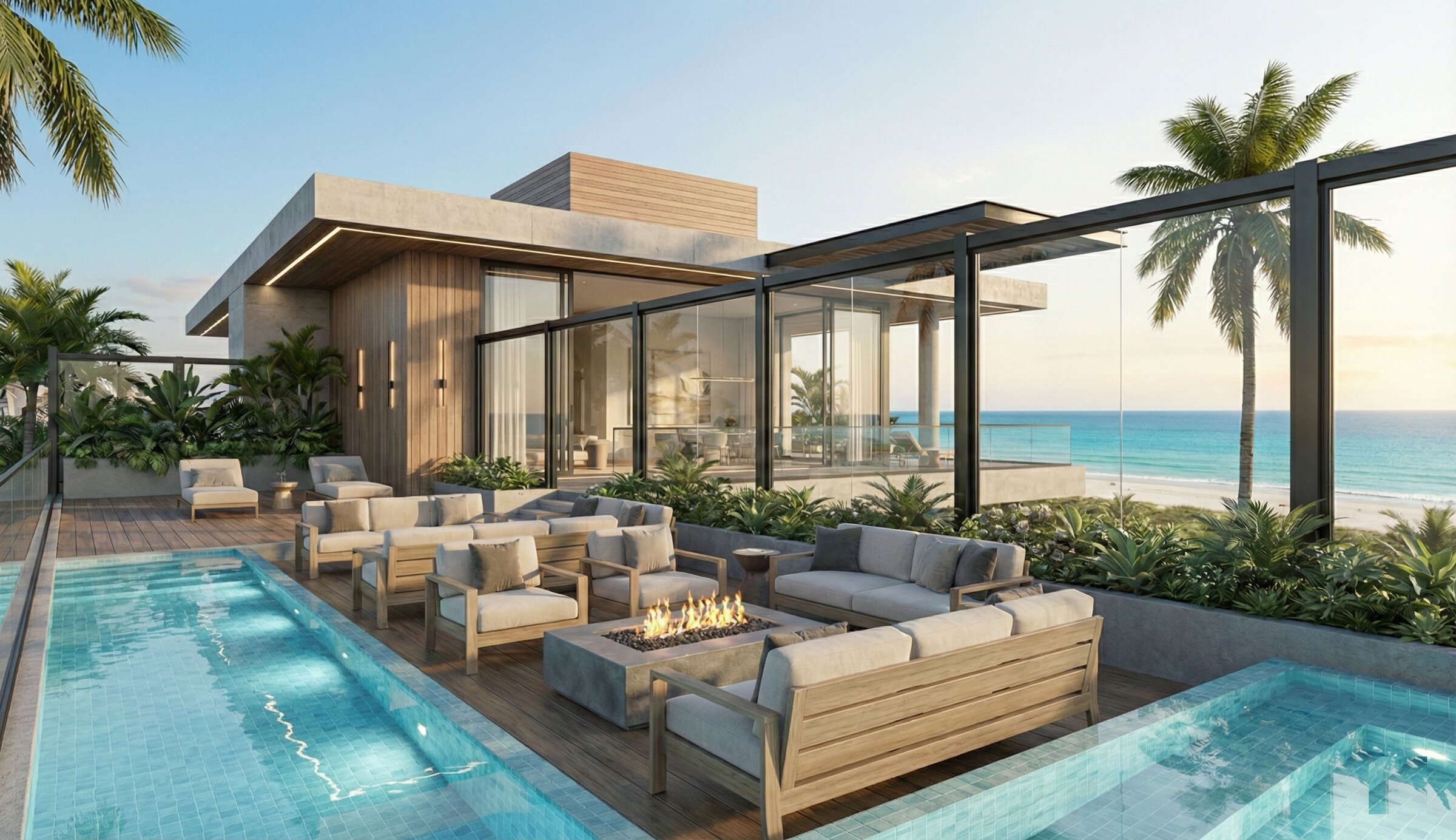
Coastal Corrosion Protection
San Diego sites trade snow loads and hurricane debris for marine air, strong sun and wind exposure that changes from a bluff-top deck to a downtown rooftop. INFINITYGLASS™ modern glass fencing is specified for that setting: ASTM B117 salt-spray testing is among the system's listed standards, frames carry AAMA 2605 powder coat with marine-grade finish options, and the system is backed by a 10 year warranty with a no-rust guarantee. An optional EnduroShield self-cleaning coating reduces routine glass cleaning. Design wind speed is not one citywide number; the engineer of record determines it for each site and exposure under ASCE 7-22, as referenced by the 2025 CBC.
Recommended Systems for San Diego
Salt air exposure at this coastal location requires marine-grade materials throughout every glass installation. INFINITYGLASS specifies 316 stainless steel hardware, marine-grade anodized aluminum channels, and UV-resistant sealants that withstand constant salt spray without degradation. All finishes are rated for coastal exposure.
Boundless Frameless Railing
Engineered for San Diego conditions with site-specific calculations and local code compliance.
Learn more →Framed Post Railing
Engineered for San Diego conditions with site-specific calculations and local code compliance.
Learn more →High-Wall Enclosure System
Engineered for San Diego conditions with site-specific calculations and local code compliance.
Learn more →Popular Projects in San Diego
Building Codes & Regulations
San Diego permit applications submitted on or after January 1, 2026, the state effective date, must conform to the 2025 California Building Code (Title 24, Part 2). The City of San Diego's local amendments, adopted under Ordinance O-22080, took effect April 22, 2026. The City said it would honor the 2022 edition for earlier applications that staff find substantially conform to submittal requirements, and that applications in their fourth and final extension may have to meet the 2025 code. Glass in guards is governed by CBC Section 2407. INFINITYGLASS™ prepares PE-stamped drawings to the edition the City confirms for your permit, so confirm the controlling code with Development Services in writing first.
INFINITYGLASS™ provides PE-stamped engineering drawings for permit submittal in San Diego and all California jurisdictions. California Building Codes Guide →
| Item | Requirement |
|---|---|
| Governing code, applications filed on or after Jan 1, 2026 | 2025 California Building Code (Title 24, Part 2) |
| Applications filed before Jan 1, 2026 | City honors the 2022 edition if staff find the application substantially conforms to submittal requirements; applications in a fourth and final extension may have to meet the 2025 code |
| City of San Diego local amendments | Ordinance O-22080, effective April 22, 2026 |
| Glass in guards | CBC Section 2407. INFINITYGLASS™ glass meets ANSI Z97.1 and CPSC 16 CFR 1201: Boundless 1/2 in low-iron tempered with a 9/16 in laminated upgrade; Framed up to 3/4 in |
| Wind design | Site-specific, ASCE 7-22 as referenced by the 2025 CBC. Framed railing product rating: 125 to 200 MPH, engineered to the site (a product rating, not a San Diego design wind speed) |
| Residential pool enclosure | 60 in minimum height, no more than 2 in clearance at the bottom, openings that stop a 4 in sphere (California Health and Safety Code Section 115923) |
| Coastal Height Limit | 30 ft maximum building height in the Coastal Height Limitation Overlay Zone (SDMC Section 132.0505); confirm with City staff whether rooftop glass counts toward measured height |
| Step | Detail |
|---|---|
| Confirm jurisdiction | Upland sites need a City building permit. Non-exempt work in the City's Coastal Overlay Zone also needs a City Coastal Development Permit (SDMC 126.0702(a)); sites in Coastal Commission permit jurisdiction go to the Commission; a split site needs a permit from each agency for its portion. |
| Port tidelands | Bayfront and Embarcadero sites go through Port of San Diego Development Services: contact the Port's Real Estate Asset Manager first, then file an Initial Services Request and a Tenant Project Application. |
| Confirm code edition | Ask Development Services in writing whether the 2022 or 2025 CBC controls your application before drawings are stamped. |
| Intake, fee and setup | Development Services pre-screens the submittal, checks completeness and sets fees; review starts after plan check fees are paid. |
| Review and corrections | Each discipline issues a cycle report. Corrections go back only after every discipline finishes, as one combined resubmittal. |
| Permit issuance | The permit issues after review and verification. Current queue times are posted on the City's permit timeline page. |
| Optional: Express Plan Check | Paid service with review 40 to 50 percent faster than standard, requested at the initial application (administrative fee plus 1.5 times the plan check fee). Not available for Rapid Review or for single-family, duplex and ADU permits. |
The 30-Foot Coastal Height Limit, Coastal Permits and the Rose Canyon Fault
San Diego Municipal Code Section 132.0505 caps buildings and additions in the Coastal Height Limitation Overlay Zone at 30 feet, and only a vote of San Diego voters can change it. The zone runs from the northern city limits to the Mexico border, inland to the 1971 alignment of Interstate 5, with named exempt areas such as the Midway-Pacific Highway Community Plan area. For a rooftop terrace or podium amenity inside the zone, that cap shapes every element above the roofline. Whether a glass guard counts toward measured height is a City staff determination, so raise it before design is fixed.
Coastal review also decides scope. Minor additions and repair work can be exempt from a Coastal Development Permit under SDMC Section 126.0704, but those exemptions narrow near coastal bluff edges and wetlands. Confirm the exemption or permit route with the City before ordering.
The Rose Canyon Fault Zone runs through the San Diego urban core; a 2024 GPS analysis published by the USGS put its slip rate through the city at about 2.4 mm per year. For a glass guard, that makes the connection a design item. The engineer of record sets the seismic design category and site class for each project, and the INFINITYGLASS™ engineering package is PE-stamped, with HSS ASTM A500 Grade B steel posts on the Framed system.
Illustrative planning scenario (not a completed project): an owner adds a 4 ft glass guard to a rear deck near a coastal bluff edge inside the Coastal Overlay Zone. The sequence is (1) confirm the exemption or Coastal Development Permit route, (2) confirm the controlling code edition with Development Services, (3) PE-stamped drawings for a Boundless or Framed railing, (4) building permit, (5) install. Where height is tight, start from the standard 4 ft railing and confirm any 6 ft to 13 ft enclosure with the plan reviewer first.
Bluff, Bayfront, Downtown: Three San Diego Install Conditions
On bluff and canyon-lot decks, coastal review bites hardest, so resolve the permit route first; a base-mounted Boundless railing keeps the ocean sightline clean, and a Framed post-supported system fits where the substrate or wind exposure favors posts. On the bayfront and Embarcadero, work on Port tidelands follows the Port of San Diego's own permit route, and marine air makes finish selection the main material decision: marine-grade options and AAMA 2605 powder coat. Downtown and Mission Valley multifamily balconies and rooftops, from 50 to more than 500 linear feet, are core Boundless and Framed applications, with the seismic connection designed for each building.
Frequently Asked Questions: Glass Fencing in San Diego
What building code applies to a San Diego glass railing project?
The 2025 California Building Code (Title 24, Part 2) took effect statewide January 1, 2026, and the City of San Diego's local amendments took effect April 22, 2026 under Ordinance O-22080. Permitting is through the City's Development Services Department. We provide PE-stamped drawings for submittal.
Do San Diego installations need seismic engineering?
Yes. San Diego is a high-seismic coastal region, so guard connections are engineered for seismic drift and dynamic loading. Every installation ships with California-specific PE-stamped structural calculations.
How does coastal air affect glass railing hardware in San Diego?
The glass itself is unaffected; low-iron glass keeps ocean views color-true, and an easy-clean coating reduces maintenance from salt film.
Can I install glass railing on a coastal bluff lot?
Yes, with the right review: bluff-adjacent and coastal-overlay sites may carry additional local requirements, and exposed sites are engineered for their actual wind exposure. We support the documentation for both.
Does INFINITYGLASS serve the whole San Diego region?
Yes. We ship factory-direct from Oceanside to Chula Vista and east through the inland suburbs, with PE-stamped engineering and submittal-ready documentation.
Does my San Diego permit use the 2022 or the 2025 building code?
Applications submitted on or after January 1, 2026 must conform to the 2025 California Building Code. The City said it would honor the 2022 edition for earlier applications that substantially conform to submittal requirements. Confirm the controlling code in writing with Development Services before drawings are stamped.
Do I need a Coastal Development Permit for a glass railing in San Diego?
It depends on the site. Non-exempt work inside the City's Coastal Overlay Zone needs a City Coastal Development Permit, sites in Coastal Commission jurisdiction go to the Commission, and Port tidelands go through the Port of San Diego. Minor additions and repairs are often exempt, but exemptions narrow near coastal bluff edges. We supply the engineering documents; the jurisdiction determination is made with the City.
Is there a height limit that affects rooftop glass in San Diego's coastal zone?
San Diego Municipal Code Section 132.0505 sets a 30 foot building height limit in the Coastal Height Limitation Overlay Zone, with named exempt areas. Whether a guard counts toward measured height is a question for City staff, so confirm it early.