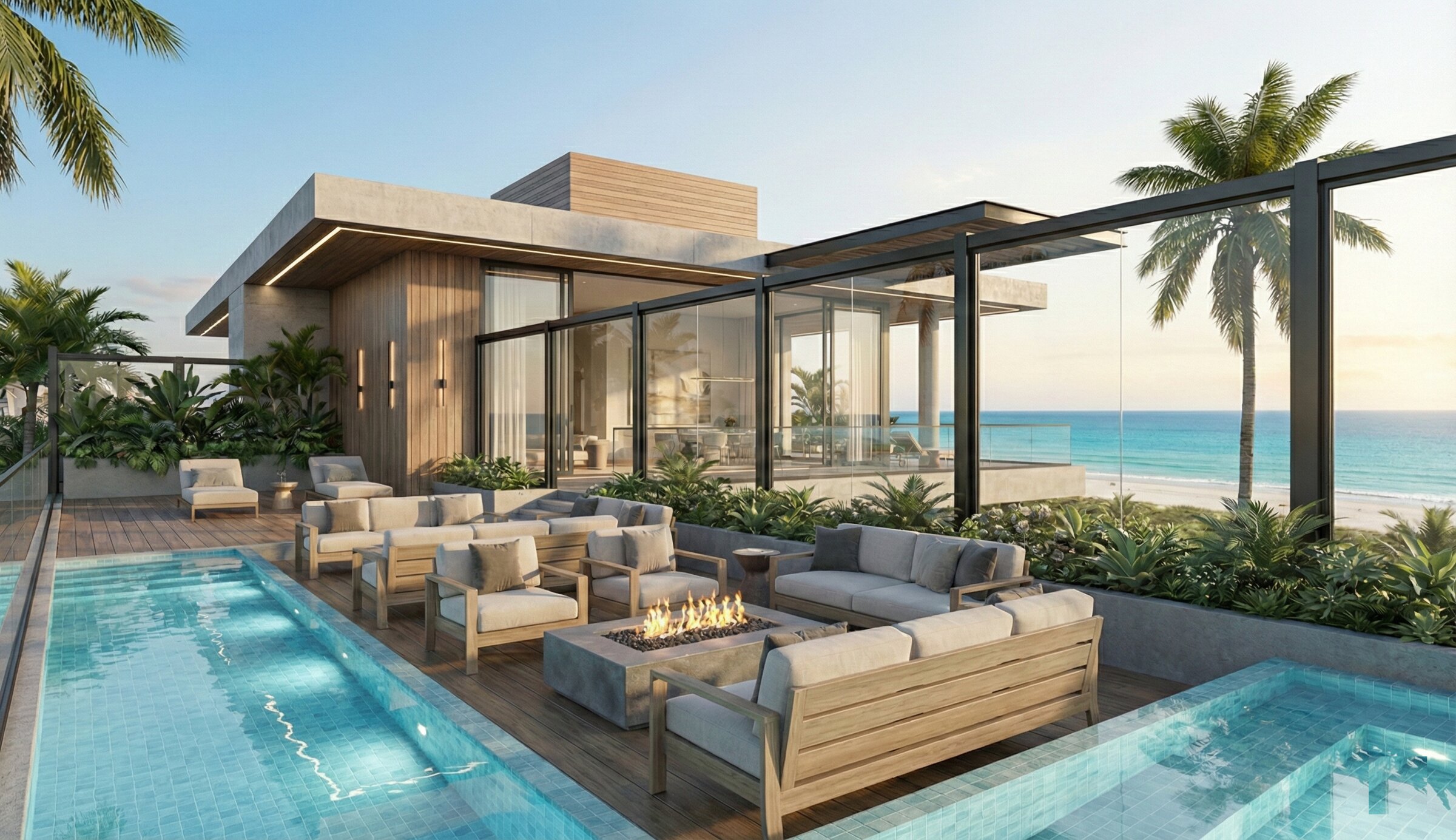
Coastal Corrosion Protection
San Francisco's marine climate is mild (roughly 45 F to 75 F most of the year) but demanding in its own way: persistent fog and salt air call for 316-grade stainless hardware for corrosion resistance, and the city's famous microclimate wind, strongest in the western neighborhoods and on rooftops, makes transparent wind screening one of the most common reasons owners choose glass in the first place. Baseline design wind speeds in coastal Northern California run roughly 92 to 96 mph (3-second gust, ASCE 7-16, Risk Category II), with exposed hilltop and rooftop sites engineered for their actual exposure. Low-iron glass keeps views crisp through fog-filtered light, and seismic loading, not wind, governs the connection engineering.
Recommended Systems for San Francisco
Salt air exposure at this coastal location requires marine-grade materials throughout every glass installation. INFINITYGLASS specifies 316 stainless steel hardware, marine-grade anodized aluminum channels, and UV-resistant sealants that withstand constant salt spray without degradation. All finishes are rated for coastal exposure.
Boundless Frameless Railing
Engineered for San Francisco conditions with site-specific calculations and local code compliance.
Learn more →Framed Post Railing
Engineered for San Francisco conditions with site-specific calculations and local code compliance.
Learn more →High-Wall Enclosure System
Engineered for San Francisco conditions with site-specific calculations and local code compliance.
Learn more →INFINITYFLEX Modular Partition
Engineered for San Francisco conditions with site-specific calculations and local code compliance.
Learn more →Popular Projects in San Francisco
Building Codes & Regulations
San Francisco permits through the Department of Building Inspection (DBI) under the 2025 San Francisco Building Code, which is the 2025 California Building Code (Title 24 Part 2, based on the 2024 IBC) as amended by San Francisco, operative January 1, 2026; projects permitted earlier are vested under the prior edition. Glass used in a guard must be laminated tempered or laminated heat-strengthened glass with a factor of safety of four (CBC Section 2407), certified to CPSC 16 CFR 1201 Category II or ANSI Z97.1 Class A, and guards must resist the code's 50 lb per linear foot and 200 lb concentrated loads. California's Swimming Pool Safety Act (Health and Safety Code Section 115923) requires residential pool enclosures at least 60 inches high with self-closing, self-latching gates, no more than a 2-inch bottom gap, no openings that pass a 4-inch sphere, and no climbable handholds or footholds; a smooth glass panel meets the no-foothold requirement by design. San Francisco is among the highest-seismic major markets in the country, so seismic drift, not wind, governs connection design, and our PE-stamped drawings carry California-specific structural calculations.
INFINITYGLASS™ provides PE-stamped engineering drawings for permit submittal in San Francisco and all California jurisdictions. California Building Codes Guide →
| Item | Requirement |
|---|---|
| Permitting authority | San Francisco Department of Building Inspection (DBI); entitlements and historic review through SF Planning; fire review through SFFD |
| Governing code | 2025 San Francisco Building Code, the 2025 California Building Code with San Francisco amendments, based on the 2024 IBC, effective 2026-01-01 |
| Guard loads | CBC 1607.9: 50 lb per linear foot, 200 lb concentrated |
| Infill and balusters | 50 lb concentrated on a 1 sq ft area |
| Guard glazing | Laminated fully tempered or heat-strengthened, CPSC 16 CFR 1201 Category II or ANSI Z97.1 Class A, 1/4 in minimum nominal |
| Wind | ASCE 7-22 per the 2024 IBC basis; value determined per site from the ASCE 7 Hazard Tool |
| Seismic | High-seismic. San Andreas and Hayward systems; liquefaction is a governing factor on Bay Mud fill in SoMa, Mission Bay and the Marina |
| Pool barrier | 60 in minimum, California Health and Safety Code 115920 to 115929 and CBC Section 3109, notably stricter than the 48 in national norm |
| Step | Detail |
|---|---|
| Guard engineering | Deferred submittal under CBC 107.3.4.1, prior building-official approval required |
| Seal required | California-licensed civil or structural PE |
| Bird-safe review | SF Planning Code Section 139 compliance, see below |
| Historic | Certificate of Appropriateness from the Historic Preservation Commission for Article 10 landmarks and districts; Article 11 covers downtown conservation districts |
| Completeness | DBI confirms application completeness within 30 days of submittal |
| Over the counter | Simple scopes can be reviewed in roughly one hour with same-day issuance |
In San Francisco, a glass guard is a bird-safety question before it is a structural one
San Francisco Planning Code Section 139 is the most consequential glass regulation in any market we serve, and it targets exactly the products a glass fencing company sells. The code defines Building Feature-Related Hazards to include free-standing glass walls, wind barriers, balconies and rooftop greenhouses with unbroken glazed segments of 24 sq ft or larger, and requires 100 percent of the glazing on those features to be treated. That is not a facade rule that incidentally catches railings. Glass balcony guards and glass wind screens are named.
Separately, Location-Related Hazards apply within 300 ft of an Urban Bird Refuge, where no more than 10 percent of the facade in the collision zone may be untreated glass, measured from grade to 60 ft, or 60 ft up from a landscaped roof of two acres or more. Historic structures are steered toward reversible treatments such as film, netting or screens.
The design consequence is that fritting, patterning and UV-reflective treatment have to be specified at the same time as the structural system, not bolted on after a plan check comment. Specifying glass in San Francisco without resolving Section 139 first is the most common way a glass guard package gets sent back.
San Francisco submarkets we serve
Mission Bay and Rincon Hill for new high-rise terrace and balcony guards. The East Cut and Transbay for tower amenity levels. SoMa and Dogpatch for adaptive reuse and interior partitions. Hayes Valley for boutique hospitality. The Embarcadero and Marina waterfront, where Exposure D and Section 139 apply together.
Frequently Asked Questions: Glass Fencing in San Francisco
What building code applies to a San Francisco glass railing project?
The 2025 San Francisco Building Code, which is the 2025 California Building Code (2024 IBC-based) as amended by San Francisco, operative January 1, 2026, permitted through the Department of Building Inspection. We provide PE-stamped drawings for DBI submittal.
Do San Francisco installations need seismic engineering?
Yes. San Francisco is a very high seismic region, so guard connections are engineered for seismic drift and dynamic loading. Every installation ships with California-specific PE-stamped structural calculations.
How tall does a pool fence need to be in San Francisco?
California requires residential pool enclosures to be at least 60 inches high (Health and Safety Code Section 115923), with self-closing, self-latching gates that open away from the water and no climbable handholds or footholds. A smooth glass panel meets the no-climb requirement by design.
Can glass fencing block the wind on a San Francisco roof deck?
Yes, that is one of the most common reasons owners choose it. A glass wind screen cuts the afternoon westerlies while preserving the view, and exposed rooftop sites are engineered above the roughly 92 to 96 mph coastal baseline (ASCE 7-16, Risk Category II) for their actual exposure.
How do fog and salt air affect glass railing hardware?
Marine air favors 316-grade stainless hardware for corrosion resistance. The glass itself is unaffected, and low-iron glass keeps clarity high in fog-filtered light; an easy-clean coating reduces maintenance from salt film.
Does INFINITYGLASS serve the wider Bay Area?
Yes. We ship factory-direct throughout San Francisco, Marin, the Peninsula, and the East Bay, with California-ready PE-stamped engineering on every order.