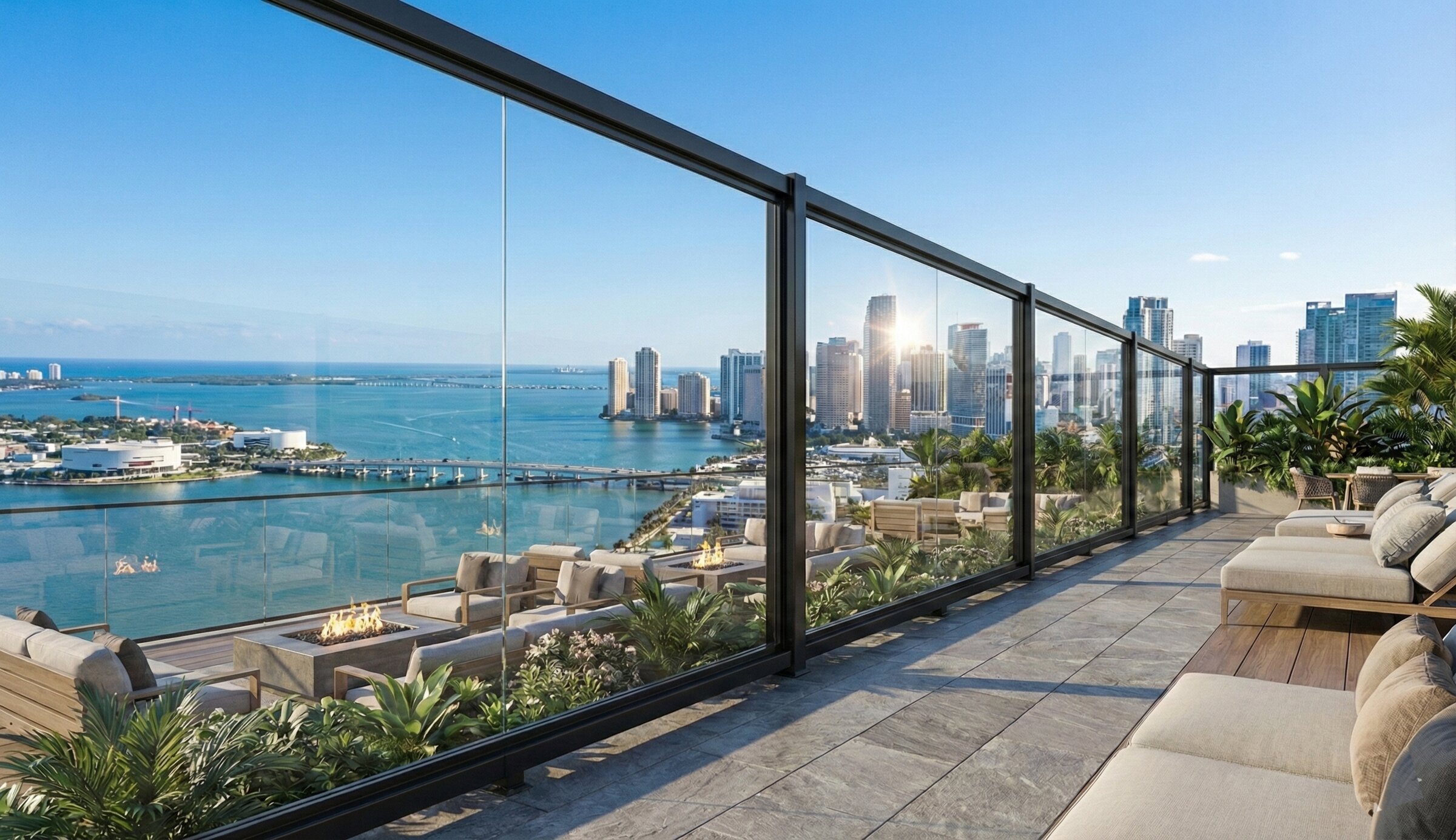
Hurricane-Zone Engineering
The bay region's climate is Tampa's with the exposure turned up: the barrier islands and Gulf-front sites take unobstructed wind off open water (Exposure D), constant salt spray, intense UV, and hurricane-season storm surge zones, with Risk Category II design wind speeds of roughly 140 to 160 mph (3-second gust) under the region's local wind lines. The engineering response is site-specific: laminated makeups rated to the actual wind line and exposure category, 316-grade stainless hardware as the default on the beaches rather than an upgrade, UV-stable finishes, and drainage detailing for tropical rain. An easy-clean coating (our EnduroShield treatment reduces cleaning effort by about 90 percent) matters most here, where Gulf salt film builds fastest.
Recommended Systems for Tampa Bay
This location falls within a hurricane-prone zone requiring impact-rated glass systems. All INFINITYGLASS exterior installations use laminated tempered glass with SGP interlayers, passing ASTM E1996 large missile impact testing and cyclic pressure protocols. Systems are engineered to meet or exceed local wind speed requirements with PE-stamped structural calculations.
High-Wall Enclosure System
Engineered for Tampa Bay conditions with site-specific calculations and local code compliance.
Learn more →Boundless Frameless Railing
Engineered for Tampa Bay conditions with site-specific calculations and local code compliance.
Learn more →Framed Post Railing
Engineered for Tampa Bay conditions with site-specific calculations and local code compliance.
Learn more →INFINITYFLEX Modular Partition
Engineered for Tampa Bay conditions with site-specific calculations and local code compliance.
Learn more →Popular Projects in Tampa Bay
Building Codes & Regulations
Tampa Bay projects permit through their local jurisdiction (St. Petersburg, Clearwater, Pinellas County, Hillsborough County, and the beach municipalities each run their own review) under the Florida Building Code, currently the 8th Edition (2023); the 9th Edition takes effect December 31, 2026. The region is not High-Velocity Hurricane Zone, but nearly all of it is windborne-debris region, and Pinellas County maintains its own local wind-speed-line amendments: Risk Category II design wind speeds run roughly 140 to 160 mph (3-second gust) across the bay, highest on the barrier islands and Gulf-front sites, where Exposure D over open water raises the effective load further. Glass used in a guard must be laminated tempered or laminated heat-strengthened glass with a factor of safety of four (FBC Section 2407), guards must resist 50 lb per linear foot and 200 lb concentrated loads, and glazed openings in the debris region must be impact-rated or protected. Florida's Residential Swimming Pool Safety Act (Chapter 515, Florida Statutes) requires a 48-inch pool barrier with self-closing, self-latching gates. Our engineering specifies each installation to its jurisdiction, wind line, and exposure category.
INFINITYGLASS™ provides PE-stamped engineering drawings for permit submittal in Tampa Bay and all Florida jurisdictions. Florida Building Codes Guide →
| Item | Requirement |
|---|---|
| Permitting authority | Pinellas County Building and Development Review Services (BDRS), Clearwater, via the Pinellas County Access Portal. Clearwater and St. Petersburg each run their own building departments with separate portals and queues |
| Partner communities | BDRS also serves Belleair Beach, Belleair Shore, Indian Rocks Beach, Kenneth City, Oldsmar and Safety Harbor |
| Governing code | FBC 8th Edition (2023), based on the 2021 IBC, referencing ASCE 7-22. 9th Edition effective 2026-12-31 |
| Guard loads | IBC 1607.9: 50 lb per linear foot, 200 lb concentrated |
| Guard glazing | Laminated fully tempered or heat-strengthened, CPSC 16 CFR 1201 Category II or ANSI Z97.1 Class A, safety factor of four |
| High-Velocity Hurricane Zone | No. HVHZ is limited to Miami-Dade and Broward. No NOA requirement |
| Windborne-debris region | Effectively the entire county. Pinellas is a narrow peninsula and virtually all of it falls within the qualifying distance of tidal water |
| WBDR definition | Within 1 mile of the coastal mean high water line where the ultimate design wind speed is 130 mph or greater, or anywhere it is 140 mph or greater (FBC 1609.2) |
| Local amendment | Pinellas amends FBC Section 1609.3 |
| Product approval | Statewide Florida Product Approval (FL #). Miami-Dade NOAs are commonly accepted as supporting test evidence but are not required |
| Seismic | Not a live design consideration |
| Pool barrier | Florida Statute Chapter 515 and FBC-R R4501.17: 48 in, 2 in maximum under-clearance, self-closing and self-latching outward-swinging gates |
| Step | Detail |
|---|---|
| Plan review | Pinellas BDRS 10 to 30 business days by project type; express permits same-day; residential around 14 days |
| Transparency | Pinellas publishes a live review-time dashboard |
| Alternative path | Private provider review is available, which is a genuine scheduling lever not offered in every Florida county |
| Seal required | Site-specific anchorage calculations sealed by a Florida PE |
| Coastal | CCCL applies on the Gulf barrier islands: DEP permit plus FBC Section 3109 |
| Flood | FEMA base flood elevation is a dominant constraint across the barrier islands and low-lying St. Petersburg |
Not HVHZ, but effectively all windborne-debris, which is a distinction that changes the specification
Tampa Bay gets specified incorrectly in both directions. It is not a High-Velocity Hurricane Zone, so there is no Miami-Dade NOA requirement and the statewide Florida Product Approval path applies. But Pinellas County is a narrow peninsula, and virtually every parcel in it sits within the qualifying distance of tidal water, which places effectively the whole county inside the windborne-debris region. Under FBC Section 1609.2 that means within one mile of the coastal mean high water line where the ultimate design wind speed reaches 130 mph, or anywhere it reaches 140 mph.
The consequence is that impact-rated glazing and debris protection are the working assumption here rather than the exception, while the approval mechanism is the lighter statewide one. Pinellas also carries its own amendment to FBC Section 1609.3, so the wind value is read against the county amendment rather than the state map alone.
The third thing worth planning around is that this is three permitting authorities, not one. Pinellas County BDRS covers unincorporated areas and six partner communities, while Clearwater and St. Petersburg each operate their own building department with its own portal and its own queue. A project two miles up the road can be a different submittal process entirely.
Tampa Bay submarkets we serve
Downtown St. Petersburg, near build-out and driving scarcity pricing on luxury towers. The EDGE District in St. Petersburg, including the 2.1-acre hotel, office and retail development and the Grow Financial headquarters tower opening 2026. Downtown Clearwater, where roughly 25 acres of county-owned land including the historic courthouse campus is in play. Clearwater Beach for resort hospitality, where CCCL and flood elevation both apply.
Frequently Asked Questions: Glass Fencing in Tampa Bay
What building code applies to glass railings around Tampa Bay?
The Florida Building Code, currently the 8th Edition (2023), applies region-wide, but each city and county (St. Petersburg, Clearwater, Pinellas, Hillsborough, and the beach municipalities) permits independently, and Pinellas maintains local wind-speed-line amendments. We prepare PE-stamped drawings to the specific jurisdiction.
Are the barrier islands engineered differently than inland sites?
Yes. Gulf-front and barrier-island sites carry Exposure D over open water on top of design wind speeds of roughly 140 to 160 mph (3-second gust, Risk Category II), so the same railing carries a heavier calculated load than it would inland. We specify the laminated makeup to the actual site.
Is Tampa Bay in the High-Velocity Hurricane Zone?
No, the HVHZ covers Miami-Dade and Broward. The bay region is, however, almost entirely windborne-debris region, so impact-rated or protected glazing rules apply, and our engineering covers them where required.
How tall does a pool fence need to be in Pinellas County?
Florida's Residential Swimming Pool Safety Act (Chapter 515) applies statewide: a barrier at least 48 inches high with self-closing, self-latching gates and no openings that pass a 4-inch sphere. Frameless glass meets this while keeping the water view open.
How does Gulf salt spray affect a glass railing?
The glass is unaffected; hardware is the exposure question, so 316-grade stainless is our default on the beaches rather than an upgrade. An easy-clean coating reduces the salt-film cleaning cycle by about 90 percent.
Does INFINITYGLASS serve the whole bay region?
Yes. We ship factory-direct across Pinellas, Hillsborough, and the surrounding coast, from Clearwater Beach through St. Petersburg to Apollo Beach, with engineering matched to each jurisdiction and wind line.